Apolipoprotein J Recombinant Rabbit Monoclonal Antibody (102), Invitrogen™
Manufacturer: Thermo Scientific
Select a Size
| Pack Size | SKU | Availability | Price |
|---|---|---|---|
| Each of 1 | PIMA530323-Each-of-1 | In Stock | ₹ 41,385.00 |
PIMA530323 - Each of 1
In Stock
Quantity
1
Base Price: ₹ 41,385.00
GST (18%): ₹ 7,449.30
Total Price: ₹ 48,834.30
Antigen
Apolipoprotein J
Classification
Recombinant Monoclonal
Concentration
1 mg/mL
Formulation
PBS with no preservative
Gene Accession No.
Q06890
Gene Symbols
Clu
Immunogen
Recombinant Mouse Clusterin/Apolipoprotein J/Apo-J Protein (Met1-Glu448)
Quantity
100μL
Primary or Secondary
Primary
Target Species
Mouse
Product Type
Antibody
Isotype
IgG
Applications
ELISA
Clone
102
Conjugate
Unconjugated
Gene
Clu
Gene Alias
AAG4; Aging associated protein 4; Aging-associated gene 4 protein; aging-associated protein 4; AI893575; apo j; Apo J a; Apo J alpha; Apo J b; Apo J beta; Apo J a; Apo J β; Apo Ja; Apo Jb; ApoJ; Apo-J; ApoJ a; ApoJ alpha; ApoJ b; ApoJ beta; ApoJ a; ApoJ β; ApoJa; ApoJalpha; ApoJb; ApoJbeta; Apolipoprotein J; CLI; Clu; CLU1; CLU2; clusterin; Clusterin alpha / beta chain; Clusterin alpha chain; Clusterin beta chain; Clustrin; Complement associated protein SP40; complement cytolysis inhibitor; Complement cytolysis inhibitor a chain; Complement cytolysis inhibitor b chain; complement lysis inhibitor; complement-associated protein SP-40,40; D14Ucla3; DAG; Dimeric acid glycoprotein; GP80; HGNC:2095; ku70-binding protein 1; Ku70-binding protein 1 (KUB1); KUB1; MGC24903; Msgp-2; NA1/NA2; RATTRPM2B; SGP2; Sgp-2; SP40; SP-40; Sugp-2; sulfated glycoprotein 2; Sulfated glycoprotein 2 (SGP2); testosterone repressed prostate message; testosterone repressed prostate message 2; Testosterone repressed prostate message 2 (TPRM2B); testosterone repressed prostate message-2; testosterone-repressed prostate message; testosterone-repressed prostate message 2; testostrone-repressed prostate message 2; Trpm2; TRPM-2; TRPM2B; Trpmb
Host Species
Rabbit
Purification Method
Protein A
Regulatory Status
RUO
Gene ID (Entrez)
12759
Content And Storage
Store at 4°C short term. For long term storage, store at -20°C, avoiding freeze/thaw cycles.
Form
Liquid
Related Products

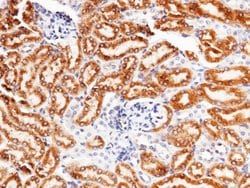
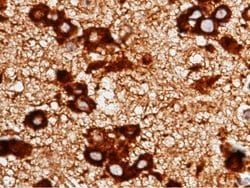
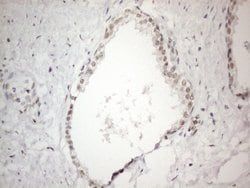
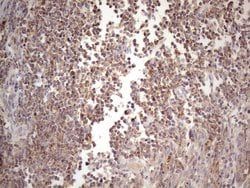
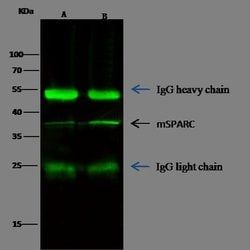
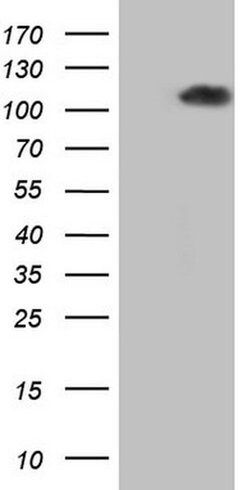
Description
- This product is preservative free
- It is recommended to add sodium azide to avoid contamination (final concentration 0.05%-0.1%)
- Recombinant rabbit monoclonal antibodies are produced using in vitro expression systems
- The expression systems are developed by cloning in the specific antibody DNA sequences from immunoreactive rabbits
- Then, individual clones are screened to select the best candidates for production
- The advantages of using recombinant rabbit monoclonal antibodies include: better specificity and sensitivity, lot-to-lot consistency, animal origin-free formulations, and broader immunoreactivity to diverse targets due to larger rabbit immune repertoire
- This antibody has specificity for Mouse Clusterin/Apolipoprotein J/Apo-J
- Isoform 1 functions as extracellular chaperone that prevents aggregation of nonnative proteins
- Prevents stress-induced aggregation of blood plasma proteins
- Inhibits formation of amyloid fibrils by APP, APOC2, B2M, CALCA, CSN3, SNCA and aggregation-prone LYZ variants (in vitro)
- Does not require ATP
- Maintains partially unfolded proteins in a state appropriate for subsequent refolding by other chaperones, such as HSPA8/HSC70
- Does not refold proteins by itself
- Binding to cell surface receptors triggers internalization of the chaperone-client complex and subsequent lysosomal or proteasomal degradation
- Secreted isoform 1 protects cells against apoptosis and against cytolysis by complement
- Intracellular isoforms interact with ubiquitin and SCF (SKP1-CUL1-F-box protein) E3 ubiquitin-protein ligase complexes and promote the ubiquitination and subsequent proteasomal degradation of target proteins
- Promotes proteasomal degradation of COMMD1 and IKBKB
- Modulates NF-kappa-B transcriptional activity
- Nuclear isoforms promote apoptosis
- Mitochondrial isoforms suppress BAX-dependent release of cytochrome c into the cytoplasm and inhibit apoptosis
- Plays a role in the regulation of cell proliferation.