Cathepsin A Recombinant Rabbit Monoclonal Antibody (108), Invitrogen™
Manufacturer: Thermo Scientific
Select a Size
| Pack Size | SKU | Availability | Price |
|---|---|---|---|
| Each of 1 | PIMA530450-Each-of-1 | In Stock | ₹ 41,385.00 |
PIMA530450 - Each of 1
In Stock
Quantity
1
Base Price: ₹ 41,385.00
GST (18%): ₹ 7,449.30
Total Price: ₹ 48,834.30
Antigen
Cathepsin A
Classification
Recombinant Monoclonal
Concentration
1 mg/mL
Formulation
PBS with no preservative
Gene Accession No.
P16675
Gene Symbols
CTSA
Immunogen
Recombinant Mouse Cathepsin A/CTSA protein (Met1-Tyr474)
Quantity
100μL
Primary or Secondary
Primary
Target Species
Mouse
Product Type
Antibody
Isotype
IgG
Applications
ELISA
Clone
108
Conjugate
Unconjugated
Gene
CTSA
Gene Alias
AU019505; beta-galactosidase 2; beta-galactosidase protective protein; carboxypeptidase C; Carboxypeptidase L; carboxypeptidase Y-like kininase; carboxypeptidase-L; cathepsin A; CTSA; deamidase; GLB2; GSL; lysosomal carboxypeptidase A; lysosomal protective protein; Lysosomal protective protein 20 kDa chain; Lysosomal protective protein 32 kDa chain; NGBE; PPCA; PPGB; protective protein cathepsin A; Protective protein for beta-galactosidase; urinary kininase
Host Species
Rabbit
Purification Method
Protein A
Regulatory Status
RUO
Gene ID (Entrez)
19025
Content And Storage
Store at 4°C short term. For long term storage, store at -20°C, avoiding freeze/thaw cycles.
Form
Liquid
Related Products

Description
- This product is preservative free
- It is recommended to add sodium azide to avoid contamination (final concentration 0.05%-0.1%)
- Recombinant rabbit monoclonal antibodies are produced using in vitro expression systems
- The expression systems are developed by cloning in the specific antibody DNA sequences from immunoreactive rabbits
- Then, individual clones are screened to select the best candidates for production
- The advantages of using recombinant rabbit monoclonal antibodies include: better specificity and sensitivity, lot-to-lot consistency, animal origin-free formulations, and broader immunoreactivity to diverse targets due to larger rabbit immune repertoire
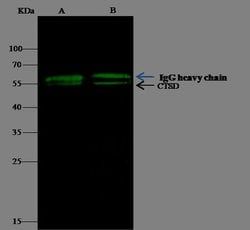
- This antibody has specificity for Mouse Cathepsin A/CTSA
- The cathepsin family of proteolytic enzymes include several diverse classes of proteases
- Cathepsins B, L, H, K, S and O comprise the cysteine protease class
- Cathepsins D and E comprise the aspartyle protease class
- The serine protease class includes cathepsin G
- Cathepsins function in cellular metabolism and participate in peptide biosynthesis and protein degradation
- Cathepsin A, a serine carboxypeptidase, exists in a high molecular weight lysosomal complex with b-galactosidase (b-gal) and a-neuraminidase (Neu1)
- Cathepsin A functions to protect b-gal and Neu1 from intralysosomal proteolysis
- Deficiencies in cathepsin A lead to deficiencies in b-gal and Neu1
- The gene encoding human cathepsin A maps to chromosome 20q13.12
- Mutations in this gene cause glactosialidosis, a lysosomal storage disorder resulting from the b-gal and Neu1 deficiencies.