ADAR Monoclonal Antibody (4E2B5), Invitrogen™
Manufacturer: Thermo Scientific
Select a Size
| Pack Size | SKU | Availability | Price |
|---|---|---|---|
| Each of 1 | PIMA531609-Each-of-1 | In Stock | ₹ 49,528.50 |
PIMA531609 - Each of 1
In Stock
Quantity
1
Base Price: ₹ 49,528.50
GST (18%): ₹ 8,915.13
Total Price: ₹ 58,443.63
Antigen
ADAR
Classification
Monoclonal
Concentration
1 mg/mL
Formulation
PBS with 0.05% sodium azide
Gene Accession No.
P55265
Gene Symbols
Adar
Immunogen
Purified recombinant fragment of human ADAR (AA: 1085-1223) expressed in E. coli.
Quantity
100 μL
Primary or Secondary
Primary
Target Species
Human
Product Type
Antibody
Isotype
IgG1
Applications
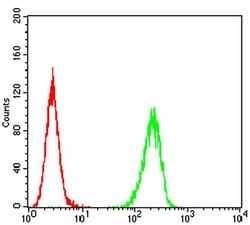
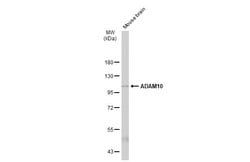
ELISA, Flow Cytometry, Western Blot
Clone
4E2B5
Conjugate
Unconjugated
Gene
Adar
Gene Alias
136 kDa double-stranded RNA-binding protein; ADA; Adar; ADAR1; Adar1p110; Adar1p150; Adenosine Deaminase; adenosine deaminase acting on RNA 1-A; adenosine deaminase RNA specific; adenosine deaminase, RNA specific; adenosine deaminase, RNA-specific; AGS6; AV242451; double-stranded RNA-specific adenosine deaminase; DRADA; DSH; DSRAD; dsRNA adenosine deaminase; dsRNA adeonosine deaminase; G1P1; IFI4; IFI-4; interferon-induced protein 4; interferon-inducible protein 4; K88DSRBP; LOW QUALITY PROTEIN: double-stranded RNA-specific adenosine deaminase; mZaADAR; P136; RNA adenosine deaminase 1; RNA-specific adenosine deaminase p110 form; RNA-specific adenosine deaminase p150 form
Host Species
Mouse
Purification Method
Protein G
Regulatory Status
RUO
Gene ID (Entrez)
103
Content And Storage
Store at 4°C short term. For long term storage, store at -20°C, avoiding freeze/thaw cycles.
Form
Liquid
Related Products
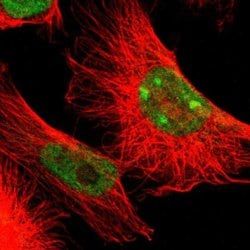
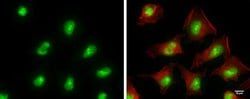

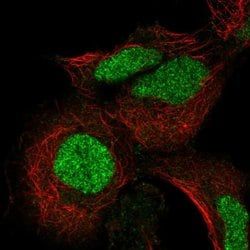
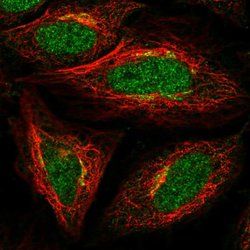

Description
- MA5-31609 has been tested in indirect ELISA
- Adenosine Deaminase RNA Specific (ADAR) catalyzes the hydrolytic deamination of adenosine to inosine in double-stranded RNA (dsRNA) referred to as A-to-I RNA editing.This may affect gene expression and function in a number of ways that include mRNA translation by changing codons and hence the amino acid sequence of proteins; pre-mRNA splicing by altering splice site recognition sequences; RNA stability by changing sequences involved in nuclease recognition; genetic stability in the case of RNA virus genomes by changing sequences during viral RNA replication; and RNA structure-dependent activities such as microRNA production or targeting or protein-RNA interactions
- ADAR can edit both viral and cellular RNAs and can edit RNAs at multiple sites (hyper-editing) or at specific sites (site-specific editing)
- Its cellular RNA substrates include: bladder cancer-associated protein (BLCAP), neurotransmitter receptors for glutamate (GRIA2) and serotonin (HTR2C) and GABA receptor (GABRA3)
- Site-specific RNA editing of transcripts encoding these proteins results in amino acid substitutions which consequently alters their functional activities
- Exhibits low-level editing at the GRIA2 Q/R site, but edits efficiently at the R/G site and HOTSPOT1
- Its viral RNA substrates include: hepatitis C virus (HCV), vesicular stomatitis virus (VSV), measles virus (MV), hepatitis delta virus (HDV), and human immunodeficiency virus type 1 (HIV-1)
- Exhibits either a proviral (HDV, MV, VSV and HIV-1) or an antiviral effect (HCV) and this can be editing-dependent (HDV and HCV), editing-independent (VSV and MV) or both (HIV-1)
- Impairs HCV replication via RNA editing at multiple sites
- Enhances the replication of MV, VSV and HIV-1 through an editing-independent mechanism via suppression of EIF2AK2/PKR activation and function
- Stimulates both the release and infectivity of HIV-1 viral particles by an editing-dependent mechanism where it associates with viral RNAs and edits adenosines in the 5'UTR and the Rev and Tat coding sequence
- Can enhance viral replication of HDV via A-to-I editing at a site designated as amber/W, thereby changing an UAG amber stop codon to an UIG tryptophan (W) codon that permits synthesis of the large delta antigen (L-HDAg) which has a key role in the assembly of viral particles
- However, high levels of ADAR1 inhibit HDV replication
- (Uniprot)