PIMA531887
RAD52 Monoclonal Antibody (5E11B2), Invitrogen™
Manufacturer: Thermo Scientific
Select a Size
| Pack Size | SKU | Availability | Price |
|---|---|---|---|
| Each of 1 | PIMA531887-Each-of-1 | In Stock | ₹ 49,350.50 |
PIMA531887 - Each of 1
In Stock
Quantity
1
Base Price: ₹ 49,350.50
GST (18%): ₹ 8,883.09
Total Price: ₹ 58,233.59
Antigen
RAD52
Classification
Monoclonal
Concentration
1 mg/mL
Formulation
PBS with 0.05% sodium azide
Gene Accession No.
P43351
Gene Symbols
RAD52
Immunogen
Purified recombinant fragment of human RAD52 (AA: 269-418) expressed in E. coli.
Quantity
100μL
Primary or Secondary
Primary
Target Species
Human
Product Type
Antibody
Isotype
IgG1
Applications
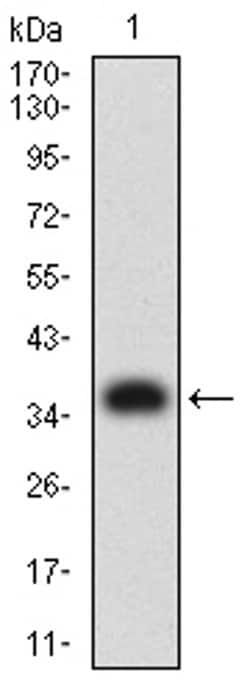
ELISA, Western Blot
Clone
5E11B2
Conjugate
Unconjugated
Gene
RAD52
Gene Alias
DNA repair protein RAD52 homolog; RAD52; RAD52 homolog (S. cerevisiae); RAD52 homolog, DNA repair protein; Rad52yh; recombination protein RAD52; rhabdomyosarcoma antigen MU-RMS-40.23
Host Species
Mouse
Purification Method
Protein G
Regulatory Status
RUO
Gene ID (Entrez)
5893
Content And Storage
Store at 4°C short term. For long term storage, store at -20°C, avoiding freeze/thaw cycles.
Form
Liquid
Related Products




Description
- MA5-31887 has been tested in indirect ELISA
- DNA double-strand breaks can be generated by exposure to ionizing radiation or through endogenous cellular reactions
- Double-strand breaks are generally thought to be repaired via one of two distinct mechanisms: homologous recombination (HR) or non-homologous end joining (NHEJ)
- Homologous recombination requires the activity of the members of the RAD52 epistasis group, which includeRAD50, RAD51, RAD52, RAD54, RDH54/TID1, RAD55, RAD57, RAD59, MRE11, and XRS2
- RAD52 can catalyze strand annealing reactions, and can form oligomers that attach to ends of single-stranded DNA.