Annexin A2 Recombinant Rabbit Monoclonal Antibody (JA42-30), Invitrogen™
Manufacturer: Thermo Scientific
Select a Size
| Pack Size | SKU | Availability | Price |
|---|---|---|---|
| Each of 1 | PIMA532689-Each-of-1 | In Stock | ₹ 53,088.50 |
PIMA532689 - Each of 1
In Stock
Quantity
1
Base Price: ₹ 53,088.50
GST (18%): ₹ 9,555.93
Total Price: ₹ 62,644.43
Antigen
Annexin A2
Classification
Monoclonal
Concentration
1 mg/mL
Formulation
TBS with 0.05% BSA, 40% Glycerol and 0.05% sodium azide, pH 7.4
Gene Accession No.
P07355, P07356, Q07936
Gene Symbols
ANXA2
Immunogen
Synthetic peptide within Human Annexin A2 aa 26-75
Quantity
100 μL
Primary or Secondary
Primary
Target Species
Human, Mouse, Rat
Product Type
Antibody
Isotype
IgG
Applications
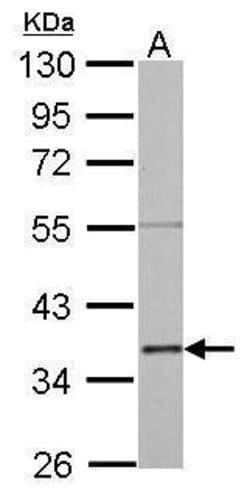
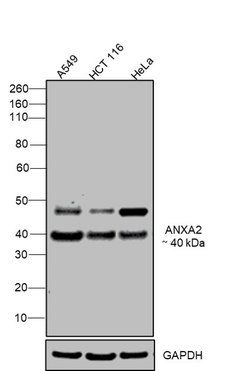
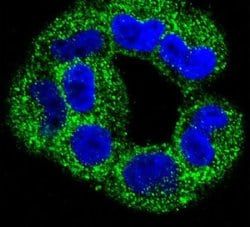
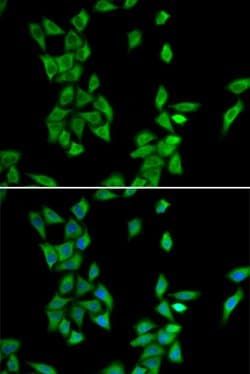
Flow Cytometry, Immunocytochemistry, Immunohistochemistry, Western Blot, Western Blot
Clone
JA42-30
Conjugate
Unconjugated
Gene
ANXA2
Gene Alias
33-kDa calcimedin, 33-kDa lymphocyte Ca<2+>- binding protein, 33kDa lymphocyte Ca<2+>- binding protein, 36-kDa calelectrin, annexin 2, annexin A2, annexin A2 isoform 2, annexin II, Annexin-2, ANX2, ANX2L4, ANXA2, AW215814, CAL1H, calpactin I heavy chain, calpactin I heavy chain (p36), calpactin I heavy polypeptide, calpactin-1 heavy chain, chromobindin 8, chromobindin-8, epididymis secretory protein Li 270, HEL-S-270, LIP2, lipocortin II, LPC2, LPC2D, p36, PAP-IV, Placental anticoagulant protein IV, protein I
Host Species
Rabbit
Purification Method
Protein A
Regulatory Status
RUO
Gene ID (Entrez)
12306, 302, 56611
Content And Storage
Store at 4°C short term. For long term storage, store at -20°C, avoiding freeze/thaw cycles.
Form
Liquid
Related Products


Description
- Recombinant rabbit monoclonal antibodies are produced using in vitro expression systems
- The expression systems are developed by cloning in the specific antibody DNA sequences from immunoreactive rabbits
- Then, individual clones are screened to select the best candidates for production
- The advantages of using recombinant rabbit monoclonal antibodies include: better specificity and sensitivity, lot-to-lot consistency, animal origin-free formulations, and broader immunoreactivity to diverse targets due to larger rabbit immune repertoire
- This gene encodes a member of the annexin family
- Members of this calcium-dependent phospholipid-binding protein family play a role in the regulation of cellular growth and in signal transduction pathways
- This protein functions as an autocrine factor which heightens osteoclast formation and bone resorption
- This gene has three pseudogenes located on chromosomes 4, 9 and 10, respectively
- Multiple alternatively spliced transcript variants encoding different isoforms have been found for this gene.