USP13 Recombinant Rabbit Monoclonal Antibody (JU72-38), Invitrogen™
Manufacturer: Thermo Scientific
Select a Size
| Pack Size | SKU | Availability | Price |
|---|---|---|---|
| Each of 1 | PIMA532802-Each-of-1 | In Stock | ₹ 47,481.50 |
PIMA532802 - Each of 1
In Stock
Quantity
1
Base Price: ₹ 47,481.50
GST (18%): ₹ 8,546.67
Total Price: ₹ 56,028.17
Antigen
USP13
Classification
Monoclonal
Concentration
1 mg/mL
Formulation
TBS with 0.05% BSA, 40% Glycerol and 0.05% sodium azide, pH 7.4
Gene Accession No.
Q5BKP2, Q92995
Gene Symbols
USP13
Immunogen
Synthetic peptide within Human USP13 aa 739-788
Quantity
100 μL
Primary or Secondary
Primary
Target Species
Human, Mouse
Product Type
Antibody
Isotype
IgG
Applications
Flow Cytometry, Immunocytochemistry, Immunoprecipitation, Western Blot, Western Blot
Clone
JU72-38
Conjugate
Unconjugated
Gene
USP13
Gene Alias
2700071E21Rik, AI848077, Deubiquitinating enzyme 13, Isopeptidase T-3, ISOT3, IsoT-3, Ubiquitin carboxyl-terminal hydrolase 13, ubiquitin specific peptidase 13, ubiquitin specific peptidase 13 (isopeptidase T-3), ubiquitin specific protease 13 (isopeptidase T-3), Ubiquitin thioesterase 13, ubiquitin thiolesterase 13, ubiquitin-specific-processing protease 13, usp13, wu:fc61g08
Host Species
Rabbit
Purification Method
Protein A
Regulatory Status
RUO
Gene ID (Entrez)
72607, 8975
Content And Storage
Store at 4°C short term. For long term storage, store at -20°C, avoiding freeze/thaw cycles.
Form
Liquid
Related Products
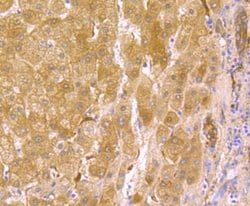
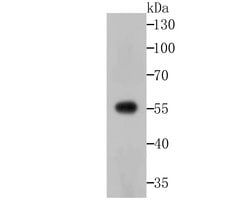
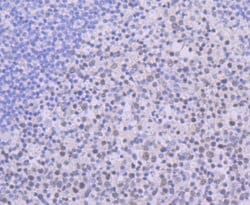
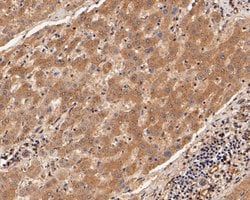
Description
- Recombinant rabbit monoclonal antibodies are produced using in vitro expression systems
- The expression systems are developed by cloning in the specific antibody DNA sequences from immunoreactive rabbits
- Then, individual clones are screened to select the best candidates for production
- The advantages of using recombinant rabbit monoclonal antibodies include: better specificity and sensitivity, lot-to-lot consistency, animal origin-free formulations, and broader immunoreactivity to diverse targets due to larger rabbit immune repertoire
- Deubiquitinase that mediates deubiquitination of target proteins such as BECN1, MITF, SKP2 and USP10 and is involved in various processes such as autophagy and endoplasmic reticulum-associated degradation (ERAD)
- Component of a regulatory loop that controls autophagy and p53/TP53 levels: mediates deubiquitination of BECN1, a key regulator of autophagy, leading to stabilize the PIK3C3/VPS34-containing complexes
- Also deubiquitinates USP10, an essential regulator of p53/TP53 stability
- In turn, PIK3C3/VPS34-containing complexes regulate USP13 stability, suggesting the existence of a regulatory system by which PIK3C3/VPS34-containing complexes regulate p53/TP53 protein levels via USP10 and USP13
- Recruited by nuclear UFD1 and mediates deubiquitination of SKP2, thereby regulating endoplasmic reticulum-associated degradation (ERAD)
- Also regulates ERAD through the deubiquitination of UBL4A a component of the BAG6/BAT3 complex
- Mediates stabilization of SIAH2 independently of deubiquitinase activity: binds ubiquitinated SIAH2 and acts by impairing SIAH2 autoubiquitination
- Has a weak deubiquitinase activity in vitro and preferentially cleaves 'Lys-63'-linked polyubiquitin chains
- In contrast to USP5, it is not able to mediate unanchored polyubiquitin disassembly
- Able to cleave ISG15 in vitro; however, additional experiments are required to confirm such data
- [UniProt]