CDK5RAP2 Monoclonal Antibody (CL3392), Invitrogen™
Manufacturer: Thermo Scientific
Select a Size
| Pack Size | SKU | Availability | Price |
|---|---|---|---|
| Each of 1 | PIMA535013-Each-of-1 | In Stock | ₹ 49,884.50 |
PIMA535013 - Each of 1
In Stock
Quantity
1
Base Price: ₹ 49,884.50
GST (18%): ₹ 8,979.21
Total Price: ₹ 58,863.71
Antigen
CDK5RAP2
Classification
Monoclonal
Conjugate
Unconjugated
Gene
CDK5RAP2
Gene Alias
C48; CDK5 activator-binding protein C48; CDK5 regulatory subunit associated protein 2; CDK5 regulatory subunit-associated protein 2; CDK5RAP2; centrosomal protein 215 kDa; Centrosome-associated protein 215; centrosomin; Cep215; KIAA1633; MCPH3
Host Species
Mouse
Purification Method
Protein A
Regulatory Status
RUO
Gene ID (Entrez)
55755
Content And Storage
Store at 4°C short term. For long term storage, store at -20°C, avoiding freeze/thaw cycles.
Form
Liquid
Applications
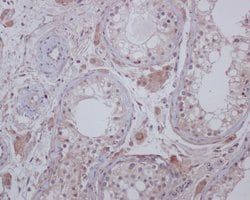
Immunocytochemistry, Immunohistochemistry
Clone
CL3392
Formulation
PBS with 40% glycerol and 0.02% sodium azide; pH 7.2
Gene Accession No.
Q96SN8
Gene Symbols
CDK5RAP2
Immunogen
Recombinant Protein corresonding to Human CDK5RAP2
Quantity
100 μL
Primary or Secondary
Primary
Target Species
Human
Product Type
Antibody
Isotype
IgG1
Related Products

Description
- Immunogen sequence: ELLEKLEKLF LNGKSVGVEM NTQNELMERI EEDNLTYQHL LPESPEPSAS HALSDYETSE KSFFSRDQKQ DNETEKTSVM V CDK5RAP2 is a regulator of CDK5 (cyclin-dependent kinase 5) activity
- The protein is localized to the centrosome and Golgi complex and interacts with CDK5R1 and pericentrin (PCNT)
- CDK5RAP2 plays a role in centriole engagement and microtubule nucleation, and has been linked to primary microcephaly and Alzheimer's disease
- Alternative splicing results in multiple transcript variants.