TrxR1 Recombinant Rabbit Monoclonal Antibody (ARC1106), Invitrogen™
Manufacturer: Thermo Scientific
Select a Size
| Pack Size | SKU | Availability | Price |
|---|---|---|---|
| Each of 1 | PIMA535564-Each-of-1 | In Stock | ₹ 47,481.50 |
PIMA535564 - Each of 1
In Stock
Quantity
1
Base Price: ₹ 47,481.50
GST (18%): ₹ 8,546.67
Total Price: ₹ 56,028.17
Antigen
TrxR1
Classification
Monoclonal
Concentration
0.45 mg/mL
Formulation
PBS with 0.05% BSA, 50% glycerol and 0.02% sodium azide; pH 7.3
Gene Accession No.
O89049, Q16881, Q9JMH6
Gene Symbols
TXNRD1
Immunogen
Recombinant fusion protein containing a sequence corresponding to amino acids 1-649 of human Thioredoxin reductase 1 (TXNRD1 ) (Q16881)
Quantity
100 μL
Primary or Secondary
Primary
Target Species
Human, Mouse, Rat
Product Type
Antibody
Isotype
IgG
Applications
Western Blot
Clone
ARC1106
Conjugate
Unconjugated
Gene
TXNRD1
Gene Alias
gene associated with retinoic and IFN-induced mortality 12 protein; gene associated with retinoic and interferon-induced mortality 12 protein; GRIM12; GRIM-12; KDRF; KM-102-derived reductase-like factor; MGC9145; NADPH-dependent thioredoxin reductase; oxidoreductase; selenoprotein oxidoreductase; testis tissue sperm-binding protein Li 46a; thioredoxin reductase 1; thioredoxin reductase 1, cytoplasmic; thioredoxin reductase GRIM-12; thioredoxin reductase TR1; TR; TR alpha; TR1; Trxr1; TXNR; Txnrd1
Host Species
Rabbit
Purification Method
Affinity Chromatography
Regulatory Status
RUO
Gene ID (Entrez)
50493, 58819, 7296
Content And Storage
-20° C, Avoid Freeze/Thaw Cycles
Form
Liquid
Related Products
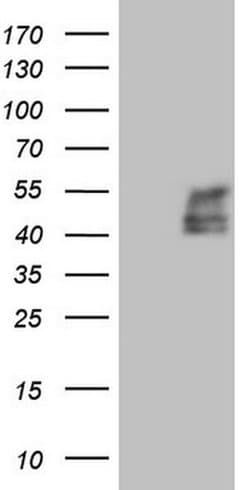
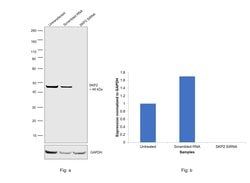
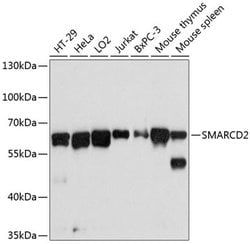
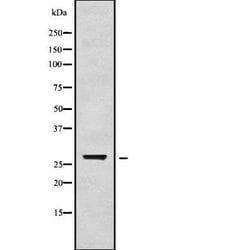
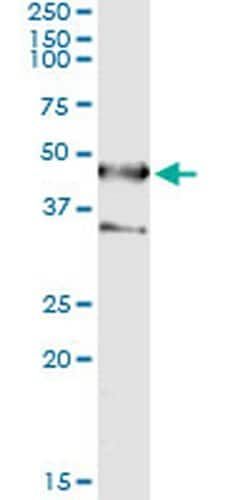

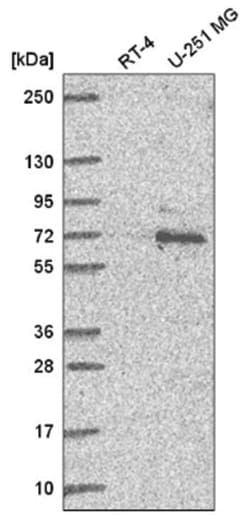
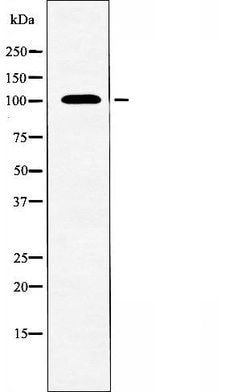
Description
- Immunogen sequence: MGCAEGKAVA AAAPTELQTK GKNGDGRRRS AKDHHPGKTL PENPAGFTST ATADSRALLQ AYIDGHSVVI FSRSTCTRCT EVKKLFKSLC VPYFVLELDQ TEDGRALEGT LSELAAETDL PVVFVKQRKI GGHGPTLKAY QEGRLQKLLK MNGPEDLPKS YDYDLIIIGG GSGGLAAAKE AAQYGKKVMV LDFVTPTPLG TRWGLGGTCV NVGCIPKKLM HQAALLGQAL QDSRNYGWKV EETVKHDWDR MIEAVQNHIG SLNWGYRVAL REKKVVYENA YGQFIGPHRI KATNNKGKEK IYSAERFLIA TGERPRYLGI PGDKEYCISS DDLFSLPYCP GKTLVVGASY VALECAGFLA GIGLDVTVMV RSILLRGFDQ DMANKIGEHM EEHGIKFIRQ FVPIKVEQIE AGTPGRLRVV AQSTNSEEII EGEYNTVMLA IGRDACTRKI GLETVGVKIN EKTGKIPVTD EEQTNVPYIY AIGDILEDKV ELTPVAIQAG RLLAQRLYAG STVKCDYENV PTTVFTPLEY GACGLSEEKA VEKFGEENIE VYHSYFWPLE WTIPSRDNNK CYAKIICNTK DNERVVGFHV LGPNAGEVTQ GFAAALKCGL TKKQLDSTIG IHPVCAEVFT TLSVTKRSGA SILQAGCUG This gene encodes a member of the family of pyridine nucleotide oxidoreductases
- This protein reduces thioredoxins as well as other substrates, and plays a role in selenium metabolism and protection against oxidative stress
- The functional enzyme is thought to be a homodimer which uses FAD as a cofactor
- Each subunit contains a selenocysteine (Sec) residue which is required for catalytic activity
- The selenocysteine is encoded by the UGA codon that normally signals translation termination
- The 3' UTR of selenocysteine-containing genes have a common stem-loop structure, the sec insertion sequence (SECIS), that is necessary for the recognition of UGA as a Sec codon rather than as a stop signal
- Alternative splicing results in several transcript variants encoding the same or different isoforms.