CD273 (B7-DC) Recombinant Rabbit Monoclonal Antibody (002), Invitrogen™
Manufacturer: Thermo Scientific
Select a Size
| Pack Size | SKU | Availability | Price |
|---|---|---|---|
| Each of 1 | PIMA535987-Each-of-1 | In Stock | ₹ 44,099.50 |
PIMA535987 - Each of 1
In Stock
Quantity
1
Base Price: ₹ 44,099.50
GST (18%): ₹ 7,937.91
Total Price: ₹ 52,037.41
Antigen
CD273 (B7-DC)
Classification
Monoclonal
Concentration
1 mg/mL
Formulation
PBS with no preservative
Gene Accession No.
Q9BQ51
Gene Symbols
PDCD1LG2
Immunogen
Recombinant Human B7-DC/PD-L2/CD273 Protein
Quantity
100 μL
Primary or Secondary
Primary
Target Species
Human
Product Type
Antibody
Isotype
IgG
Applications
Flow Cytometry
Clone
002
Conjugate
Unconjugated
Gene
PDCD1LG2
Gene Alias
B7 dendritic cell molecule; B7DC; B7-DC; bA574F11.2; Btdc; Butyrophilin B7-DC; butyrophilin-like protein; CD273; F730015O22Rik; MGC124039; MGC124040; PD1 ligand 2; PD-1 ligand 2; PD-1-ligand 2; PDCD1 ligand 2; PDCD1L2; Pdcd1lg2; Pdl2; PD-L2; Programmed cell death 1 ligand 2; programmed death ligand 2
Host Species
Rabbit
Purification Method
Protein A
Regulatory Status
RUO
Gene ID (Entrez)
80380
Content And Storage
Store at 4°C short term. For long term storage, store at -20°C, avoiding freeze/thaw cycles.
Form
Liquid
Related Products
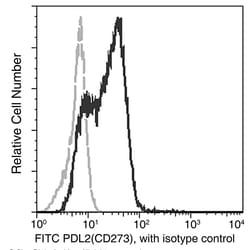

Description
- Programmed death-ligand 2 (PD-L2), or B7-DC, is a member of the B7 ligand family within the immunoglobulin superfamily that, along with programmed death-ligand 1 (PD-L1), acts as a ligand for programmed cell death protein 1 (PD-1)
- Though expressed primarily in dendritic cells, PD-L2 expression can be induced on a wide variety of immune and non-immune cells depending on the microenvironment
- PD-L2 expression is particularly upregulated in the presence of Th2 cytokine, IL-4, as well as Th1 cytokines, TNF-alpha and IFN-gamma to a lesser degree
- While generally expressed at lower levels compared to PD-L1, PD-L2 demonstrates a 2 to 6 times higher relative affinity to PD-1 than PD-L1
- PD-1 and its ligands are referred to as inhibitory immune checkpoint molecules in that they provide useful negative feedback during physiological homeostasis
- Ligation of PD-L2 or PD-L1 inhibits activation, proliferation, and cytokine secretion (e.g
- IFN-gamma, IL-10) in T cells, μgtimately dampening immune response
- Conversely, studies have shown that PD-L2 can also stimulate T cell proliferation and cytokine production, even in PD-1-deficient T cells, suggesting additional receptors
- Recent studies have concluded that PD-L2 also binds to a second receptor, repulsive guidance molecule b (RGMb), which was originally identified as a receptor for bone morphogenetic proteins (BMPs)
- RGMb is expressed in the central nervous system, as well as in macrophages, however, its role in immunity is only beginning to emerge
- Interaction between PD-L2 and RGMb regulates the development of respiratory tolerance in the lung through BMP and/or neogenin signaling pathways
- The naturally occurring human PD-L2 monomer consists of a 201-amino-acid extracellular domain, a 21-amino-acid transmembrane domain, and a 32-amino-acid cytoplasmic domain.