OPRK1 Polyclonal Antibody, Invitrogen™
Manufacturer: Thermo Scientific
Select a Size
| Pack Size | SKU | Availability | Price |
|---|---|---|---|
| Each of 1 | PIPA124534-Each-of-1 | In Stock | ₹ 49,083.50 |
PIPA124534 - Each of 1
In Stock
Quantity
1
Base Price: ₹ 49,083.50
GST (18%): ₹ 8,835.03
Total Price: ₹ 57,918.53
Antigen
OPRK1
Classification
Polyclonal
Conjugate
Unconjugated
Gene
OPRK1
Gene Alias
kappa opioid receptor; kappa-type opioid receptor; KOPR1; KOR; K-OR-1; KOR-1; MSL-1; Opiate receptor, kappa-1; opioid receptor kappa 1; opioid receptor, kappa 1; opioid receptor, kappa 2; OPRK; OPRK1; Oprk2; Ork1; R21; Ror-d
Host Species
Rabbit
Purification Method
Antigen affinity chromatography
Regulatory Status
RUO
Gene ID (Entrez)
29335, 4986
Content And Storage
Store at 4°C short term. For long term storage, store at -20°C, avoiding freeze/thaw cycles.
Form
Liquid
Applications
Immunohistochemistry (Paraffin)
Concentration
1 mg/mL
Formulation
PBS with 0.1% sodium azide
Gene Accession No.
P34975, P41145
Gene Symbols
OPRK1
Immunogen
Synthetic peptide, KLH conjugated, corresponding to the second extracellular domain of human kappa-1 Opioid Receptor.
Quantity
25 μg
Primary or Secondary
Primary
Target Species
Human, Rat
Product Type
Antibody
Isotype
IgG
Related Products
Description
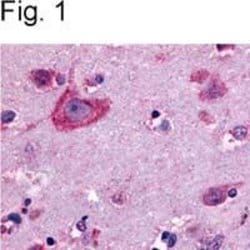
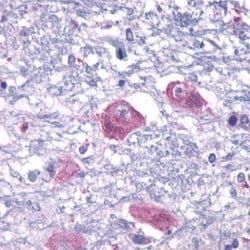
- Positive control: rat brain
- This gene encodes an opioid receptor, which is a member of the 7 transmembrane-spanning G protein-coupled receptor family
- It functions as a receptor for endogenous ligands, as well as a receptor for various synthetic opioids
- Ligand binding results in inhibition of adenylate cyclase activity and neurotransmitter release
- This opioid receptor plays a role in the perception of pain and mediating the hypolocomotor, analgesic and aversive actions of synthetic opioids
- Variations in this gene have also been associated with alcohol dependence and opiate addiction
- Alternatively spliced transcript variants encoding different isoforms have been found for this gene
- A recent study provided evidence for translational readthrough in this gene, and expression of an additional C-terminally extended isoform via the use of an alternative in-frame translation termination codon.