PIPA130616
SP3 Polyclonal Antibody, Invitrogen™
Manufacturer: Thermo Scientific
Select a Size
| Pack Size | SKU | Availability | Price |
|---|---|---|---|
| Each of 1 | PIPA130616-Each-of-1 | In Stock | ₹ 49,083.50 |
PIPA130616 - Each of 1
In Stock
Quantity
1
Base Price: ₹ 49,083.50
GST (18%): ₹ 8,835.03
Total Price: ₹ 57,918.53
Antigen
SP3
Classification
Polyclonal
Conjugate
Unconjugated
Gene
SP3
Gene Alias
D130027J01Rik; DKFZp686O1631; GC-binding transcription factor Sp3; SP3; Sp3 transcription factor; specificity protein 3; SPR1; SPR-1; SPR2; SPR-2; trans-acting transcription factor 3; transcription factor Sp3
Host Species
Rabbit
Purification Method
purified
Regulatory Status
RUO
Gene ID (Entrez)
20687, 367846, 6670
Content And Storage
4° C, do not freeze
Form
Liquid
Applications
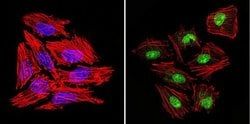
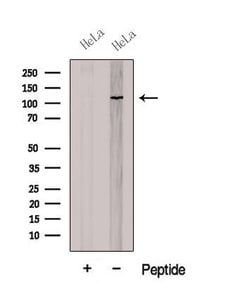
Immunocytochemistry, Western Blot
Concentration
0.2 mg/mL
Formulation
PBS with 0.2% gelatin and 0.1% sodium azide
Gene Accession No.
O70494, Q02447
Gene Symbols
SP3
Immunogen
Synthetic peptide mapping to the carboxy terminus of human Sp3.
Quantity
1 mL
Primary or Secondary
Primary
Target Species
Human, Mouse, Rat
Product Type
Antibody
Isotype
IgG
Related Products

Description
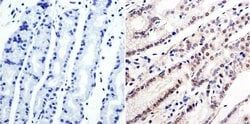
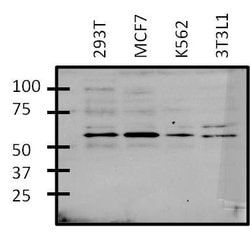
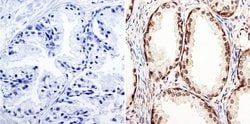
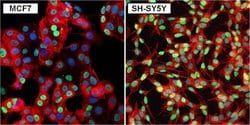
- PA1-30616 detects Sp3 from mouse, rat, human samples
- This gene belongs to a family of Sp1 related genes that encode transcription factors that regulate transcription by binding to consensus GC- and GT-box regulatory elements in target genes
- This protein contains a zinc finger DNA-binding domain and several transactivation domains, and has been reported to function as a bifunctional transcription factor that either stimulates or represses the transcription of numerous genes
- Transcript variants encoding different isoforms have been described for this gene, and one has been reported to initiate translation from a non-AUG (AUA) start codon
- Additional isoforms, resulting from the use of alternate downstream translation initiation sites, have also been noted
- A related pseudogene has been identified on chromosome 13.