GPR65 Polyclonal Antibody, Invitrogen™
Manufacturer: Thermo Scientific
Select a Size
| Pack Size | SKU | Availability | Price |
|---|---|---|---|
| Each of 1 | PIPA132515-Each-of-1 | In Stock | ₹ 46,591.50 |
PIPA132515 - Each of 1
In Stock
Quantity
1
Base Price: ₹ 46,591.50
GST (18%): ₹ 8,386.47
Total Price: ₹ 54,977.97
Antigen
GPR65
Classification
Polyclonal
Conjugate
Unconjugated
Gene
GPR65
Gene Alias
Dig1; G protein-coupled receptor 65; Gpcr25; Gpr65; G-protein coupled receptor 25; G-protein coupled receptor 65; hTDAG8; Psychosine receptor; T cell death associated protein 8; T-cell death-associated gene 8 protein; TDAG8
Host Species
Rabbit
Purification Method
Antigen affinity chromatography
Regulatory Status
RUO
Gene ID (Entrez)
8477
Content And Storage
Store at 4°C short term. For long term storage, store at -20°C, avoiding freeze/thaw cycles.
Form
Liquid
Applications
Immunohistochemistry (Paraffin)
Concentration
1 mg/mL
Formulation
PBS with 0.1% sodium azide
Gene Accession No.
Q8IYL9
Gene Symbols
GPR65
Immunogen
Synthetic 16 amino acid peptide from 1st cytoplasmic domain of human GPR65
Quantity
25 μg
Primary or Secondary
Primary
Target Species
Human
Product Type
Antibody
Isotype
IgG
Related Products
Description
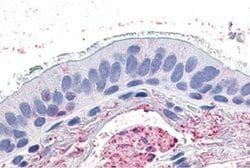
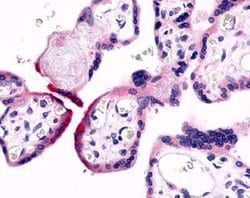
- Description PA1-32515 detects GPR65 from human samples
- GPR65 also known as TDAG8 is a transmembrane protein belonging to the G protein coupled receptor super family with 337-amino acid and 90% similarity and 81% identity in the 7 transmembrane domains of its mouse homolog
- It has 3 potential N-linked glycosylation sites and is expressed predominantly in lymphoid organs and cancer tissues with increased expression during activation-induced death of T-cell hybridomas
- Two major transcripts of 4.5 kb and 1.8 kb are found in peripheral blood leukocytes and functions as a novel proton-sensing receptor
- It couples to adenylyl cyclase and psychosine and is also actively involved in the establishment of immunological autotolerance
- GPR65 has a role in cellular transformation by RhoA activation and actin rearrangement under conditions accompanying tissue acidosis.