LPAR4 Polyclonal Antibody, Invitrogen™
Manufacturer: Thermo Scientific
Select a Size
| Pack Size | SKU | Availability | Price |
|---|---|---|---|
| Each of 1 | PIPA132651-Each-of-1 | In Stock | ₹ 48,905.50 |
PIPA132651 - Each of 1
In Stock
Quantity
1
Base Price: ₹ 48,905.50
GST (18%): ₹ 8,802.99
Total Price: ₹ 57,708.49
Antigen
LPAR4
Classification
Polyclonal
Conjugate
Unconjugated
Gene
Lpar4
Gene Alias
5730485F04Rik; G protein-coupled receptor 23; Gpr23; G-protein coupled receptor 23; LPA receptor 4; LPA4; LPA-4; LPA4 Receptor; Lpar4; Lysophosphatidic acid receptor 4; P2RY9; P2Y purinoceptor 9; P2Y5-LIKE; P2Y5-like receptor; p2y9; Purinergic receptor 9; RGD1563686
Host Species
Rabbit
Purification Method
Antigen affinity chromatography
Regulatory Status
RUO
Gene ID (Entrez)
2846
Content And Storage
Store at 4°C short term. For long term storage, store at -20°C, avoiding freeze/thaw cycles.
Form
Liquid
Applications
Immunohistochemistry (Paraffin)
Concentration
1 mg/mL
Formulation
PBS with 0.1% sodium azide
Gene Accession No.
Q99677
Gene Symbols
Lpar4
Immunogen
Synthetic 17 amino acid peptide from 3rd cytoplasmic domain of human GPR23
Quantity
25 μg
Primary or Secondary
Primary
Target Species
Human
Product Type
Antibody
Isotype
IgG
Related Products
Description
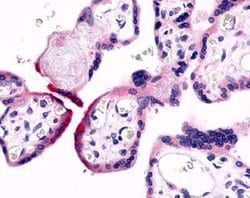
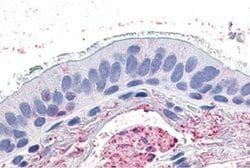
- Description PA1-32651 detects GPR23 from human samples
- EDG4 belongs to a family of G-protein coupled receptors whose ligands are lysophospholipids
- There are eight known members of the EDG receptor family and they are implicated in mediating growth-related effects such as induction of cellular proliferation, alterations in differentiation and survival, and suppression of apoptosis
- They also evoke cellular effector functions that are dependent on cytoskeletal responses such as contraction, secretion, adhesion and chemotaxis
- EDG receptors are developmentally regulated and differ in tissue distribution
- They couple to multiple types of G proteins to signal through ras and MAP kinase, rho, phospholipase C, and several protein tyrosine kinases
- EDG4 is expressed in testes, ovarian tumor, and leukocyte containing tissues.