PIPA132755
GPR132 Polyclonal Antibody, Invitrogen™
Manufacturer: Thermo Scientific
Select a Size
| Pack Size | SKU | Availability | Price |
|---|---|---|---|
| Each of 1 | PIPA132755-Each-of-1 | In Stock | ₹ 49,083.50 |
PIPA132755 - Each of 1
In Stock
Quantity
1
Base Price: ₹ 49,083.50
GST (18%): ₹ 8,835.03
Total Price: ₹ 57,918.53
Antigen
GPR132
Classification
Polyclonal
Conjugate
Unconjugated
Gene
GPR132
Gene Alias
G protein-coupled receptor 132; G protein-coupled receptor G2A; G2 accumulation protein; G2a; GPR132; MGC99642; Probable G-protein coupled receptor 132
Host Species
Rabbit
Purification Method
Antigen affinity chromatography
Regulatory Status
RUO
Gene ID (Entrez)
29933
Content And Storage
Store at 4°C short term. For long term storage, store at -20°C, avoiding freeze/thaw cycles.
Form
Liquid
Applications
Immunohistochemistry (Paraffin)
Concentration
1 mg/mL
Formulation
PBS with 0.1% sodium azide
Gene Accession No.
Q9UNW8
Gene Symbols
GPR132
Immunogen
Synthetic 18 amino acid peptide from 3rd extracellular domain of human GPCR G2A
Quantity
25 μg
Primary or Secondary
Primary
Target Species
Human
Product Type
Antibody
Isotype
IgG
Related Products
Description
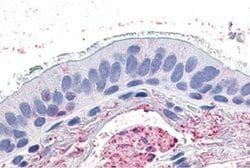
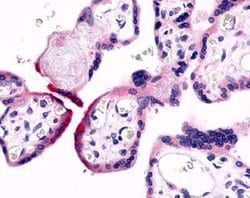
- Description PA1-32755 detects GPCR G2A from human samples
- GPCR G2A is a G-protein linked receptor for lysophosphatidylcholine (LPC)
- It may play a role as a sensor of LPC levels at sites of inflammation to limit tissue-infiltrating-cells and progression to overt autoimmune disease and functions at the G2/M checkpoint to delay mitosis
- It also may serve as a mechanism for T and B cells, and other cell types, to slow their proliferation and repair damaged DNA
- It is highly expressed in macrophages and hematopoietic tissues rich in lymphocytes, like spleen and thymus, but weakly expressed in heart and lung
- In atherosclerotic plaques, expression was observed around the lipid core and at the shoulder region
- It is induced by DNA-damaging agents.