GHSR Polyclonal Antibody, Invitrogen™
Manufacturer: Thermo Scientific
Select a Size
| Pack Size | SKU | Availability | Price |
|---|---|---|---|
| Each of 1 | PIPA132875-Each-of-1 | In Stock | ₹ 48,905.50 |
PIPA132875 - Each of 1
In Stock
Quantity
1
Base Price: ₹ 48,905.50
GST (18%): ₹ 8,802.99
Total Price: ₹ 57,708.49
Antigen
GHSR
Classification
Polyclonal
Conjugate
Unconjugated
Gene
Ghsr
Gene Alias
C530020I22Rik; GHDP; GH-releasing peptide receptor; Ghrelin receptor; GHRP; Ghrp receptor; GHS receptor; GHSR; GHS-R; G-protein coupled receptor; growth hormone secretagogue receptor; growth hormone secretagogue receptor type 1
Host Species
Rabbit
Purification Method
Antigen affinity chromatography
Regulatory Status
RUO
Gene ID (Entrez)
2693
Content And Storage
Store at 4°C short term. For long term storage, store at -20°C, avoiding freeze/thaw cycles.
Form
Liquid
Applications
Immunohistochemistry (Paraffin)
Concentration
1 mg/mL
Formulation
PBS with 0.1% sodium azide
Gene Accession No.
Q92847
Gene Symbols
Ghsr
Immunogen
Synthetic 13 amino acid peptide from N-terminal extracellular domain of human GHS-R1
Quantity
25 μg
Primary or Secondary
Primary
Target Species
Human
Product Type
Antibody
Isotype
IgG
Related Products
Description
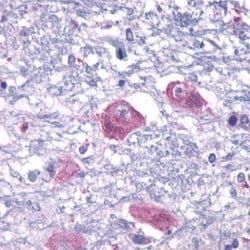
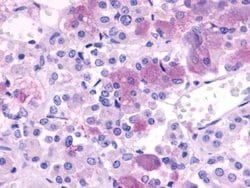
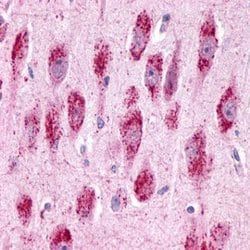
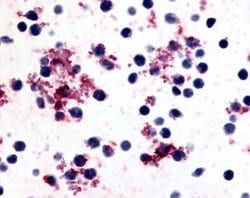
- Description PA1-32875 detects GHSR from human samples
- Growth hormone secretagogue receptor 1a (GHSR) is a member of the G-protein coupled receptor family
- GHSR may play a role in energy homeostasis and regulation of body weight
- Two identified transcript variants are expressed in several tissues and are evolutionary conserved in fish and swine
- One transcript, 1a, excises an intron and encodes the functional protein; this protein is the receptor for the Ghrelin ligand and defines a neuroendocrine pathway for growth hormone release
- The second transcript (1b) retains the intron and does not function as a receptor for Ghrelin; however, it may function to attenuate activity of isoform 1a
- Mutations to the gene can cause isolated partial growth hormone deficiency.