PIPA1836A64
SNX1 Polyclonal Antibody, Alexa Fluor™ 647, Invitrogen™
Manufacturer: Thermo Scientific
Select a Size
| Pack Size | SKU | Availability | Price |
|---|---|---|---|
| Each of 1 | PIPA1836A64-Each-of-1 | In Stock | ₹ 38,003.00 |
PIPA1836A64 - Each of 1
In Stock
Quantity
1
Base Price: ₹ 38,003.00
GST (18%): ₹ 6,840.54
Total Price: ₹ 44,843.54
Antigen
SNX1
Classification
Polyclonal
Conjugate
Alexa Fluor 647
Gene
SNX1
Gene Alias
HsT17379; MGC8664; Snx1; SNX1A; sorting nexin 1; sorting nexin 1A; sorting nexin-1; VPS5
Host Species
Rabbit
Purification Method
Antigen affinity chromatography
Regulatory Status
RUO
Gene ID (Entrez)
56440, 6642
Content And Storage
4° C, store in dark, DO NOT FREEZE!
Form
Liquid
Applications
Immunocytochemistry
Concentration
1.0 mg/mL
Formulation
PBS with 1.0mg/mL BSA and 0.05% sodium azide
Gene Accession No.
Q13596, Q9WV80
Gene Symbols
SNX1
Immunogen
Synthetic peptide corresponding to residues Q(139) E D Q F D L T V G I T D P E K I(155) of human SNX1.
Quantity
50 μg
Primary or Secondary
Primary
Target Species
Human, Mouse
Product Type
Antibody
Isotype
IgG
Related Products

Description
- The PA1-836 immunogen is a synthetic peptide corresponding to residues Q(139) E D Q F D L T V G I T D P E K I(155) of human SNX1
- This peptide (Cat
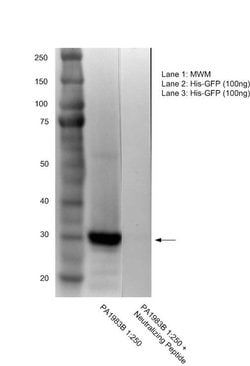
- # PEP-286) is available for use in neutralization and control experiments
- This gene encodes a member of the sorting nexin family
- Members of this family contain a phox (PX) domain, which is a phosphoinositide binding domain, and are involved in intracellular trafficking
- This endosomal protein regulates the cell-surface expression of epidermal growth factor receptor
- This protein also has a role in sorting protease-activated receptor-1 from early endosomes to lysosomes
- This protein may form oligomeric complexes with family members
- This gene results in three transcript variants encoding distinct isoforms.