MNT Polyclonal Antibody, Invitrogen™
Manufacturer: Thermo Scientific
Select a Size
| Pack Size | SKU | Availability | Price |
|---|---|---|---|
| Each of 1 | PIPA5101990-Each-of-1 | In Stock | ₹ 46,502.50 |
PIPA5101990 - Each of 1
In Stock
Quantity
1
Base Price: ₹ 46,502.50
GST (18%): ₹ 8,370.45
Total Price: ₹ 54,872.95
Antigen
MNT
Classification
Polyclonal
Conjugate
Unconjugated
Gene
MNT
Gene Alias
BHLHD3; Class D basic helix-loop-helix protein 3; MAD6; max binding protein; MAX network transcriptional repressor; max-binding protein MNT; Max-interacting protein; MNT; MNT, MAX dimerization protein; MXD6; Myc antagonist MNT; Protein ROX; Rox
Host Species
Rabbit
Purification Method
Affinity chromatography
Regulatory Status
RUO
Gene ID (Entrez)
4335
Content And Storage
-20°C
Form
Liquid
Applications
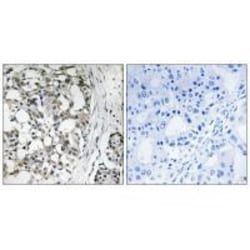
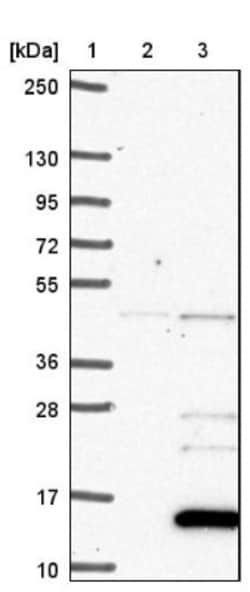
Immunocytochemistry, Immunohistochemistry (Paraffin), Western Blot
Concentration
1 mg/mL
Formulation
PBS with 50% glycerol and 0.02% sodium azide; pH 7.4
Gene Accession No.
Q99583
Gene Symbols
MNT
Immunogen
A synthesized peptide derived from human MNT(Accession Q99583), corresponding to amino acid residues R314-L364.
Quantity
100 μL
Primary or Secondary
Primary
Target Species
Human
Product Type
Antibody
Isotype
IgG
Related Products


Description
- Antibody detects endogenous levels of total MNT
- The Myc/Max/Mad network comprises a group of transcription factors that co-interact to regulate gene-specific transcriptional activation or repression
- This gene encodes a protein member of the Myc/Max/Mad network
- This protein has a basic-Helix-Loop-Helix-zipper domain (bHLHzip) with which it binds the canonical DNA sequence CANNTG, known as the E box, following heterodimerization with Max proteins
- This protein is likely a transcriptional repressor and an antagonist of Myc-dependent transcriptional activation and cell growth
- This protein represses transcription by binding to DNA binding proteins at its N-terminal Sin3-interaction domain.