CELSR1 Polyclonal Antibody, Invitrogen™
Manufacturer: Thermo Scientific
Select a Size
| Pack Size | SKU | Availability | Price |
|---|---|---|---|
| Each of 1 | PIPA5111506-Each-of-1 | In Stock | ₹ 48,905.50 |
PIPA5111506 - Each of 1
In Stock
Quantity
1
Base Price: ₹ 48,905.50
GST (18%): ₹ 8,802.99
Total Price: ₹ 57,708.49
Antigen
CELSR1
Classification
Polyclonal
Conjugate
Unconjugated
Gene
CELSR1
Gene Alias
ADGRC1; adhesion G protein-coupled receptor C1; cadherin EGF LAG seven-pass G-type receptor 1; Cadherin family member 9; cadherin, EGF LAG seven-pass G-type receptor 1 (flamingo homolog, Drosophila); CDHF9; CELSR1; Flamingo homolog 2; FMI2; hFmi2; ME2; protocadherin flamingo 2
Host Species
Rabbit
Purification Method
Antigen affinity chromatography
Regulatory Status
RUO
Gene ID (Entrez)
9620
Content And Storage
Store at 4°C short term. For long term storage, store at -20°C, avoiding freeze/thaw cycles.
Form
Liquid
Applications
Immunocytochemistry
Concentration
0.14 mg/mL
Formulation
PBS with 40% glycerol and 0.02% sodium azide; pH 7.2
Gene Accession No.
Q9NYQ6
Gene Symbols
CELSR1
Immunogen
Recombinant Protein corresonding to Human CELSR1
Quantity
100 μL
Primary or Secondary
Primary
Target Species
Human
Product Type
Antibody
Isotype
IgG
Related Products

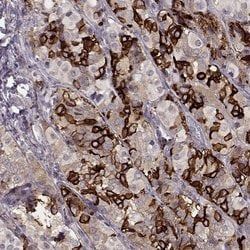
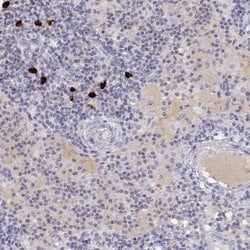
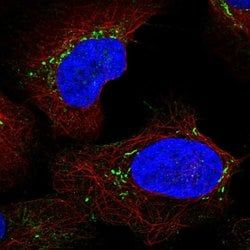
Description
- Immunogen sequence: KHLKGVLGGR KLHLEDSATT RATLLTRSLN CNTTFGDGPD MLRTDLGEST ASLDSIVRDE GIQKLGVSSG LVRGSHGEPD ASLMPRSCKD CELSR1 is a member of the flamingo subfamily, part of the cadherin superfamily
- The flamingo subfamily consists of nonclassic type cadherins; a subpopulation that does not interact with catenins
- The flamingo cadherins are located at the plasma membrane and have nine cadherin domains, seven epidermal growth factor like repeats and two laminin A G type repeats in their ectodomain
- They also have seven transmembrane domains, a characteristic unique to this subfamily
- It is postulated that these proteins are receptors involved in contact mediated communication, with cadherin domains acting as homophilic binding regions and the EGF like domains involved in cell adhesion and receptor ligand interactions
- This particular member is a developmentally regulated, neural specific gene which plays an unspecified role in early embryogenesis.