PIPA5112119
Nurim Polyclonal Antibody, Invitrogen™
Manufacturer: Thermo Scientific
Select a Size
| Pack Size | SKU | Availability | Price |
|---|---|---|---|
| Each of 1 | PIPA5112119-Each-of-1 | In Stock | ₹ 43,120.50 |
PIPA5112119 - Each of 1
In Stock
Quantity
1
Base Price: ₹ 43,120.50
GST (18%): ₹ 7,761.69
Total Price: ₹ 50,882.19
Antigen
Nurim
Classification
Polyclonal
Conjugate
Unconjugated
Gene
NRM
Gene Alias
2610307M02Rik; AI429796; DAAP-285E11.8; Nrm; NRM29; Nuclear envelope membrane protein; nuclear rim protein; Nurim; nurim (nuclear envelope membrane protein); UNQ555/PRO1112
Host Species
Rabbit
Purification Method
Antigen affinity chromatography, Protein A
Regulatory Status
RUO
Gene ID (Entrez)
11270
Content And Storage
Store at 4°C short term. For long term storage, store at -20°C, avoiding freeze/thaw cycles.
Form
Liquid
Applications
Immunohistochemistry (Paraffin), Immunoprecipitation, Western Blot
Concentration
1 mg/mL
Formulation
PBS with no preservative
Gene Accession No.
Q8IXM6
Gene Symbols
NRM
Immunogen
A synthetic peptide corresponding to the center region of the Human NRM/Nurim
Quantity
100 μL
Primary or Secondary
Primary
Target Species
Human
Product Type
Antibody
Isotype
IgG
Related Products
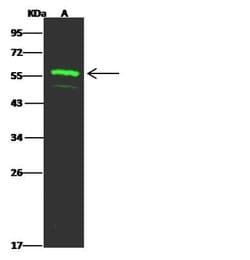
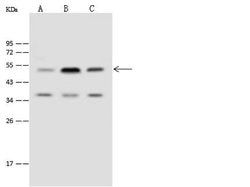
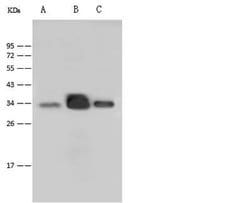
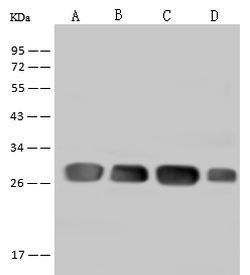
Description
- This antibody reacts with: Human, Pig (Species predicted to react based on 100% sequence homology)
- Nurim is an inner nuclear membrane (INM) protein that is tightly associated with the inner nuclear membrane
- It was first isolated in a visual screen for nuclear envelope-localizing proteins
- In subcellular fractionation, nurim remained extremely tightly bound to nuclear fractions
- Unlike the known nuclear envelope (NE) membrane proteins, it is neither associated with nuclear pores, nor targeted like lamin-associated membrane proteins suggesting its localization to NE by a distinct mechanism.