WDR4 Polyclonal Antibody, Invitrogen™
Manufacturer: Thermo Scientific
Select a Size
| Pack Size | SKU | Availability | Price |
|---|---|---|---|
| Each of 1 | PIPA5112269-Each-of-1 | In Stock | ₹ 42,497.50 |
PIPA5112269 - Each of 1
In Stock
Quantity
1
Base Price: ₹ 42,497.50
GST (18%): ₹ 7,649.55
Total Price: ₹ 50,147.05
Antigen
WDR4
Classification
Polyclonal
Conjugate
Unconjugated
Gene
WDR4
Gene Alias
AI415180; AI448349; D530049K22Rik; hWH; mWH; Protein Wuho homolog; TRM82; TRM82 tRNA methyltransferase 82 homolog; TRMT82; tRNA (guanine-N(7)-)-methyltransferase non-catalytic subunit WDR4; tRNA (guanine-N(7)-)-methyltransferase subunit WDR4; WD repeat domain 4; WD repeat-containing protein 4; WD40 repeat protein 4; WDR4
Host Species
Rabbit
Purification Method
Antigen affinity chromatography, Protein A
Regulatory Status
RUO
Gene ID (Entrez)
10785
Content And Storage
Store at 4°C short term. For long term storage, store at -20°C, avoiding freeze/thaw cycles.
Form
Liquid
Applications
Immunohistochemistry (Paraffin), Immunoprecipitation, Western Blot
Concentration
1 mg/mL
Formulation
PBS with 0.03% ProClin 300; pH 7
Gene Accession No.
P57081
Gene Symbols
WDR4
Immunogen
E. coli-derived Human WDR4 fragment
Quantity
100 μL
Primary or Secondary
Primary
Target Species
Human
Product Type
Antibody
Isotype
IgG
Related Products
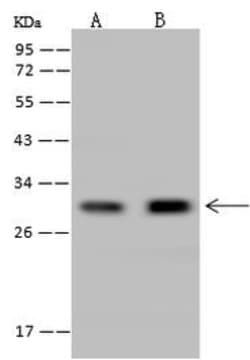
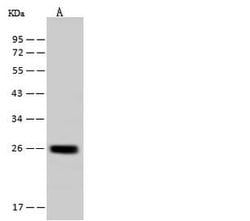
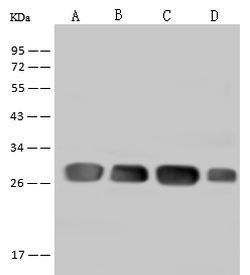
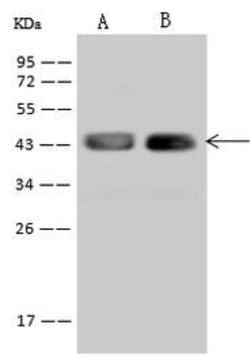
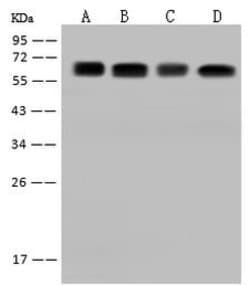
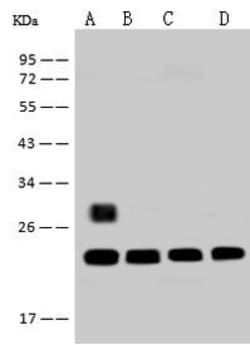
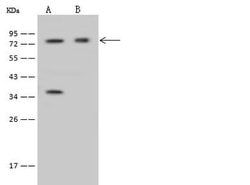
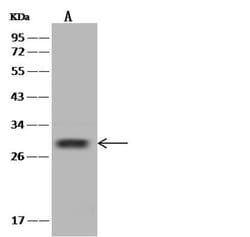
Description
- Required for 7-methylguanosine modification of tRNA
- This protein is a member of the WD repeat protein family
- WD repeats are minimally conserved regions of approximately 40 amino acids typically bracketed by gly-his and trp-asp (GH-WD)
- which may facilitate formation of heterotrimeric or multiprotein complexes
- Members of this family are involved in a variety of cellular processes
- including cell cycle progression
- signal transduction
- apoptosis
- and gene regulation
- This protein is excluded as a candidate for a form of nonsyndromic deafness (DFNB10)
- but is still a candidate for other disorders mapped to 21q22.3 as well as for the development of Down syndrome phenotypes
- Alternative splicing of this gene generates at least 3 transcript variants
- two of which diverge at the 3' UTR and thus encode the same protein products.