PIPA5112700
RPL19 Polyclonal Antibody, Invitrogen™
Manufacturer: Thermo Scientific
Select a Size
| Pack Size | SKU | Availability | Price |
|---|---|---|---|
| Each of 1 | PIPA5112700-Each-of-1 | In Stock | ₹ 42,853.50 |
PIPA5112700 - Each of 1
In Stock
Quantity
1
Base Price: ₹ 42,853.50
GST (18%): ₹ 7,713.63
Total Price: ₹ 50,567.13
Antigen
RPL19
Classification
Polyclonal
Conjugate
Unconjugated
Gene
RPL19
Gene Alias
60S ribosomal protein L19; DKFZp779D216; FLJ27452; HGNC:10312; L19; Large ribosomal subunit protein eL19; MGC71997; ribosomal protein L19; RPL19
Host Species
Rabbit
Purification Method
Protein G
Regulatory Status
RUO
Gene ID (Entrez)
19921, 6143
Content And Storage
-20°C or -80°C if preferred
Form
Liquid
Applications
ELISA, Immunocytochemistry, Immunohistochemistry (Paraffin), Western Blot
Concentration
3 mg/mL
Formulation
PBS with 50% glycerol and 0.03% ProClin 300; pH 7.4
Gene Accession No.
P84098, P84099
Gene Symbols
RPL19
Immunogen
Recombinant Human 60S ribosomal protein L19 protein (79-196AA)
Quantity
100 μg
Primary or Secondary
Primary
Target Species
Human, Mouse
Product Type
Antibody
Isotype
IgG
Related Products
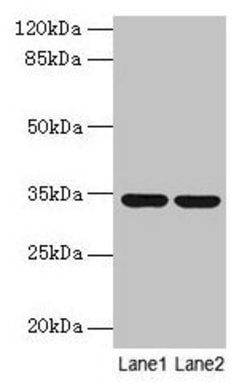
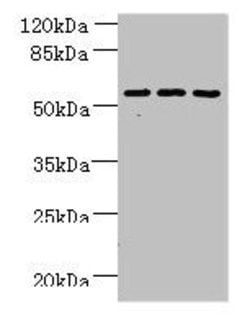
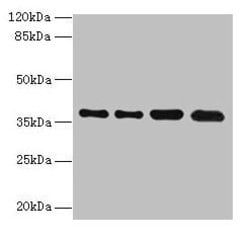
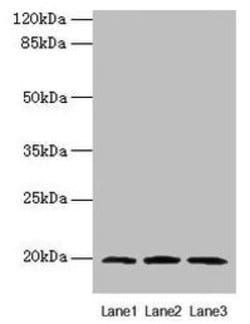
Description
- Ribosomes, the organelles that catalyze protein synthesis, consist of a small 40S subunit and a large 60S subunit
- Together these subunits are composed of 4 RNA species and approximately 80 structurally distinct proteins
- This gene encodes a ribosomal protein that is a component of the 60S subunit
- The protein belongs to the L19E family of ribosomal proteins
- It is located in the cytoplasm
- As is typical for genes encoding ribosomal proteins, there are multiple processed pseudogenes of this gene dispersed through the genome.