PIPA5113573
TULP1 Polyclonal Antibody, Invitrogen™
Manufacturer: Thermo Scientific
Select a Size
| Pack Size | SKU | Availability | Price |
|---|---|---|---|
| Each of 1 | PIPA5113573-Each-of-1 | In Stock | ₹ 46,502.50 |
PIPA5113573 - Each of 1
In Stock
Quantity
1
Base Price: ₹ 46,502.50
GST (18%): ₹ 8,370.45
Total Price: ₹ 54,872.95
Antigen
TULP1
Classification
Polyclonal
Conjugate
Unconjugated
Gene
TULP1
Gene Alias
LCA15; RP14; RP3-340B19.1; tubby like protein 1; tubby like protein 1 like; tubby-like protein 1; Tubby-related protein 1; TUBL1; Tulp1; Tulp1l
Host Species
Rabbit
Purification Method
Affinity chromatography
Regulatory Status
RUO
Gene ID (Entrez)
7287
Content And Storage
-20° C, Avoid Freeze/Thaw Cycles
Form
Liquid
Applications
Western Blot
Concentration
0.5 mg/mL
Formulation
PBS with 2% sucrose and 0.09% sodium azide
Gene Accession No.
O00294
Gene Symbols
TULP1
Immunogen
Synthetic peptide directed towards the middle region of human TULP1
Quantity
100 μL
Primary or Secondary
Primary
Target Species
Human
Product Type
Antibody
Isotype
IgG
Related Products
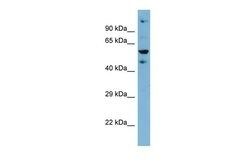
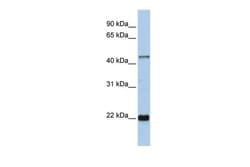

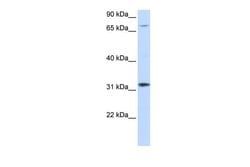
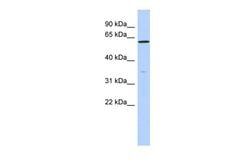
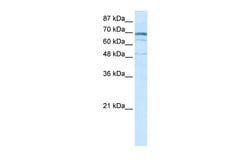
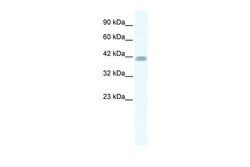
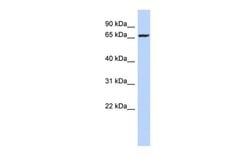
Description
- Immunogen sequence: EEEEAATVIK KSNQKGKAKG KGKKKAKEER APSPPVEVDE PREFVLRPAP For short term use, store at 2-8°C up to 1 week
- For long term storage, store at -20°C in small aliquots to prevent freeze-thaw cycles
- Predicted homology: Cow: 100%; Dog: 100%; Guinea Pig: 91%; Horse: 100%; Human: 100%; Mouse: 85%; Rabbit: 100%; Rat: 91%; Yeast: 100% TULP1 is a member of the tubby-like gene family (TULPs)
- Members of this family have been identified in plants, vertebrates, and invertebrates
- TULP proteins share a conserved C-terminal region of approximately 200 amino acid residues
- The protein encoded by this gene is thought to play a role in the physiology of photoreceptors
- Mutations in this gene are associated with recessive juvenile retinitis pigmentosa and Leber congenital amaurosis-15.