Fe65 Polyclonal Antibody, Invitrogen™
Manufacturer: Thermo Scientific
Select a Size
| Pack Size | SKU | Availability | Price |
|---|---|---|---|
| Each of 1 | PIPA5114296-Each-of-1 | In Stock | ₹ 46,502.50 |
PIPA5114296 - Each of 1
In Stock
Quantity
1
Base Price: ₹ 46,502.50
GST (18%): ₹ 8,370.45
Total Price: ₹ 54,872.95
Antigen
Fe65
Classification
Polyclonal
Conjugate
Unconjugated
Gene
APBB1
Gene Alias
adaptor protein FE65a2; amyloid beta (A4) precursor protein-binding, family B, member 1; amyloid beta (A4) precursor protein-binding, family B, member 1 (Fe65); amyloid beta A4 precursor protein-binding family B member 1; amyloid beta precursor protein binding family B member 1; Amyloid-beta A4 precursor protein-binding family B member 1; APBB1; FE65; MGC:9072; Protein Fe65; RIR; stat-like protein
Host Species
Rabbit
Purification Method
Affinity chromatography
Regulatory Status
RUO
Gene ID (Entrez)
322
Content And Storage
-20° C, Avoid Freeze/Thaw Cycles
Form
Liquid
Applications
Western Blot
Concentration
0.5 mg/mL
Formulation
PBS with 2% sucrose and 0.09% sodium azide
Gene Accession No.
O00213
Gene Symbols
APBB1
Immunogen
Synthetic peptide directed towards the N-terminal region of Human APBB1
Quantity
100 μL
Primary or Secondary
Primary
Target Species
Human
Product Type
Antibody
Isotype
IgG
Related Products
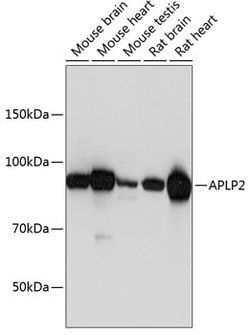
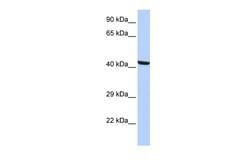
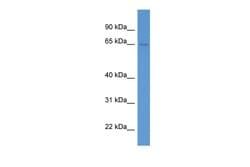
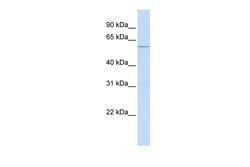
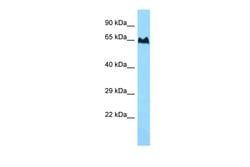
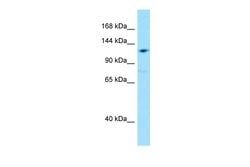
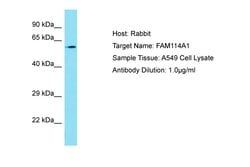
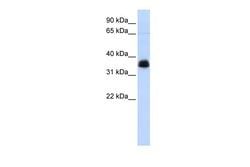
Description
- Immunogen sequence: QALTDGPREH SKSASLLFGM RNSAASDEDS SWATLSQGSP SYGSPEDTDS For short term use, store at 2-8°C up to 1 week
- For long term storage, store at -20°C in small aliquots to prevent freeze-thaw cycles
- The protein encoded by this gene is a member of the Fe65 protein family
- It is an adaptor protein localized in the nucleus
- It interacts with the Alzheimer's disease amyloid precursor protein, transcription factor CP2/LSF/LBP1 and the low-density lipoprotein receptor-related protein
- APP functions as a cytosolic anchoring site that can prevent the gene product's nuclear translocation
- This encoded protein could play an important role in the pathogenesis of Alzheimer's disease
- It is thought to regulate transcription
- Also it is observed to block cell cycle progression by downregulating thymidylate synthase expression
- Multiple alternatively spliced transcript variants have been described for this gene but some of their full length sequence is not known.