KCNN3 Polyclonal Antibody, Invitrogen™
Manufacturer: Thermo Scientific
Select a Size
| Pack Size | SKU | Availability | Price |
|---|---|---|---|
| Each of 1 | PIPA5115457-Each-of-1 | In Stock | ₹ 46,502.50 |
PIPA5115457 - Each of 1
In Stock
Quantity
1
Base Price: ₹ 46,502.50
GST (18%): ₹ 8,370.45
Total Price: ₹ 54,872.95
Antigen
KCNN3
Classification
Polyclonal
Conjugate
Unconjugated
Gene
KCNN3
Gene Alias
hSK3; K3; KCa2.3; Kcnn3; potassium calcium-activated channel subfamily N member 3; potassium channel, calcium activated intermediate/small conductance subfamily N alpha, member 3; potassium intermediate/small conductance calcium-activated channel, subfamily N, member 3; SK3; SKCa 3; SKCa3; small conductance calcium-activated potassium channel 3; small conductance calcium-activated potassium channel protein 3; small-conductance Ca2+-activated K+ channel 3
Host Species
Rabbit
Purification Method
Affinity chromatography
Regulatory Status
RUO
Gene ID (Entrez)
140493, 3782, 54263
Content And Storage
-20°C
Form
Liquid
Applications
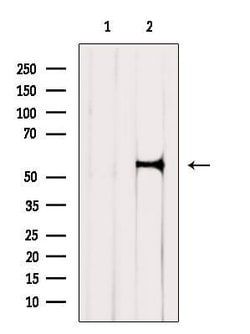
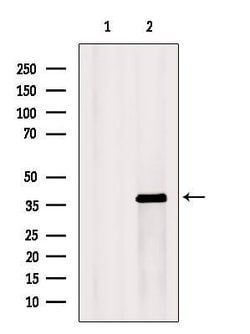
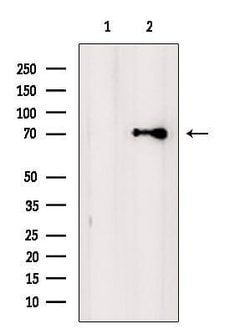
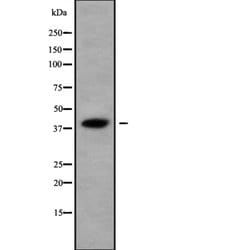
Immunocytochemistry, Immunohistochemistry (Paraffin), Western Blot
Concentration
1 mg/mL
Formulation
PBS with 50% glycerol and 0.02% sodium azide
Gene Accession No.
P58391, P70605, Q9UGI6
Gene Symbols
KCNN3
Immunogen
A synthesized peptide derived from human KCNN3(Accession Q9UGI6), corresponding to amino acid residues M1-Q33.
Quantity
100 μL
Primary or Secondary
Primary
Target Species
Human, Mouse, Rat
Product Type
Antibody
Isotype
IgG
Related Products




Description
- Antibody detects endogenous levels of total KCNN3
- Action potentials in vertebrate neurons are followed by an afterhyperpolarization (AHP) that may persist for several seconds and may have profound consequences for the firing pattern of the neuron
- Each component of the AHP is kinetically distinct and is mediated by different calcium-activated potassium channels
- KCNN3, a member of the KCNN family of potassium channel genes, encodes a protein that is activated before membrane hyperpolarization and is thought to regulate neuronal excitability by contributing to the slow component of synaptic AHP
- The encoded protein is an integral membrane protein that forms a voltage-independent calcium-activated channel with three other calmodulin-binding subunits.