PIPA5118042
MAGEA10 Polyclonal Antibody, Invitrogen™
Manufacturer: Thermo Scientific
Select a Size
| Pack Size | SKU | Availability | Price |
|---|---|---|---|
| Each of 1 | PIPA5118042-Each-of-1 | In Stock | ₹ 39,427.00 |
PIPA5118042 - Each of 1
In Stock
Quantity
1
Base Price: ₹ 39,427.00
GST (18%): ₹ 7,096.86
Total Price: ₹ 46,523.86
Antigen
MAGEA10
Classification
Polyclonal
Formulation
PBS with 0.03% ProClin 300; pH 7
Gene Accession No.
P43363
Gene Symbols
MAGEA10
Immunogen
E. coli-derived Human MAGEA10 fragment
Quantity
100 μL
Primary or Secondary
Primary
Target Species
Human
Form
Liquid
Applications
Immunohistochemistry (Paraffin), Immunoprecipitation, Western Blot
Conjugate
Unconjugated
Gene
MAGEA10
Gene Alias
cancer/testis antigen 1.10; cancer/testis antigen family 1, member 10; CT1.10; MAGE family member A10; MAGE10; MAGE-10 antigen; MAGEA10; melanoma antigen family A, 10; melanoma antigen family A10; melanoma-associated antigen 10; RGD1563693
Host Species
Rabbit
Purification Method
Antigen affinity chromatography, Protein A
Regulatory Status
RUO
Gene ID (Entrez)
4109
Content And Storage
-20° C, Avoid Freeze/Thaw Cycles
Isotype
IgG
Related Products
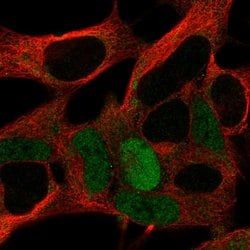



Description
- MAGEA10 is a member of the MAGEA gene family
- The members of this family have their entire coding sequences located in the last exon, and the encoded proteins show 50 to 80% sequence identity between each other
- The promoters and first exons of the MAGEA genes show considerable variability, suggesting that the existence of this gene family enables the same function to be expressed under different transcriptional controls
- The MAGEA genes are expressed at a high level in a number of tumors of various histologic types, and are silent in normal tissues with the exception of testis and placenta
- The MAGEA genes are clustered on chromosome Xq28
- They may be implicated in some hereditary disorders, such as dyskeratosis congenita.