PFKP Polyclonal Antibody, Invitrogen™
Manufacturer: Thermo Scientific
Select a Size
| Pack Size | SKU | Availability | Price |
|---|---|---|---|
| Each of 1 | PIPA5121154-Each-of-1 | In Stock | ₹ 44,811.50 |
PIPA5121154 - Each of 1
In Stock
Quantity
1
Base Price: ₹ 44,811.50
GST (18%): ₹ 8,066.07
Total Price: ₹ 52,877.57
Antigen
PFKP
Classification
Polyclonal
Conjugate
Unconjugated
Gene
PFKP
Gene Alias
1200015H23Rik; 6-phosphofructo-1-kinase, C-type; 6-phosphofructokinase type C; 6-phosphofructokinase, platelet type; 9330125N24Rik; ATP:D-fructose 6-phosphate 1-phosphotransferase; ATP-dependent 6-phosphofructokinase, platelet type; ATP-dependent 6-phosphofructokinase, platelet type {ECO:0000255; ATP-PFK; ATP-PFK {ECO:0000255; EC 2.7.1.11; HAMAP-Rule:MF_03184}; K6PP; PFK 1; PFK1; Pfkc; PFK-C; PFKF; PFKP; PFK-P; Phosphofructo-1-kinase isozyme C; Phosphofructokinase; phosphofructokinase 1; phosphofructokinase, platelet; Phosphofructokinase, platelet type; phosphohexokinase; phosphohexokinase {ECO:0000255
Host Species
Rabbit
Purification Method
Affinity Chromatography
Regulatory Status
RUO
Gene ID (Entrez)
5214, 56421, 60416
Content And Storage
-20° C, Avoid Freeze/Thaw Cycles
Form
Liquid
Applications
Immunocytochemistry, Immunohistochemistry (Paraffin), Western Blot
Concentration
0.76 mg/mL
Formulation
PBS with 50% glycerol and 0.05% ProClin 300; pH 7.3
Gene Accession No.
P47860, Q01813, Q9WUA3
Gene Symbols
PFKP
Immunogen
Recombinant fusion protein containing a sequence corresponding to amino acids 336-540 of human PFKP (NP_002618.1).
Quantity
100 μL
Primary or Secondary
Primary
Target Species
Human, Mouse, Rat
Product Type
Antibody
Isotype
IgG
Related Products

Description
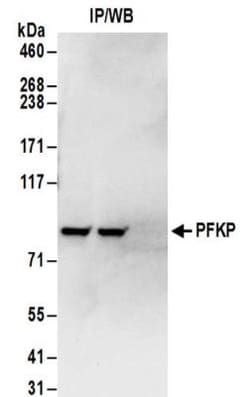
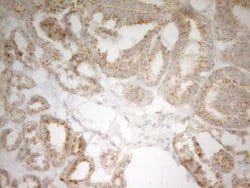
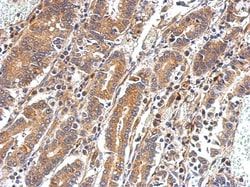
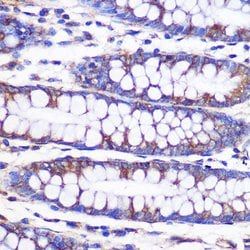
- Positive test controls include: MCF7, Jurkat, Mouse brain, Mouse heart, Rat testis, Rat brain
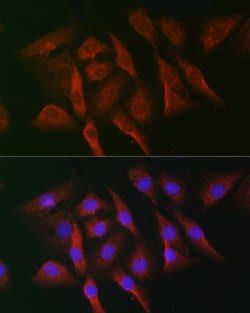
- The target is usually found in the following locations: Cytoplasm
- Immunogen sequence: ATPDTPACVV SLNGNHAVRL PLMECVQMTQ DVQKAMDERR FQDAVRLRGR SFAGNLNTYK RLAIKLPDDQ IPKTNCNVAV INVGAPAAGM NAAVRSAVRV GIADGHRMLA IYDGFDGFAK GQIKEIGWTD VGGWTGQGGS ILGTKRVLPG KYLEEIATQM RTHSINALLI IGGFEAYLGL LELSAAREKH EEFCVPMVMV PATVS Protein kinases are enzymes that transfer a phosphate group from a phosphate donor, generally the g phosphate of ATP, onto an acceptor amino acid in a substrate protein
- By this basic mechanism, protein kinases mediate most of the signal transduction in eukaryotic cells, regulating cellular metabolism, transcription, cell cycle progression, cytoskeletal rearrangement and cell movement, apoptosis, and differentiation
- With more than 500 gene products, the protein kinase family is one of the largest families of proteins in eukaryotes
- The family has been classified in 8 major groups based on sequence comparison of their tyrosine (PTK) or serine/threonine (STK) kinase catalytic domains
- The AGC kinase group consists of 63 kinases including the cyclic nucleotide-regulated protein kinase (PKA & PKG) family, the diacylglycerol-activated/phospholipid-dependent protein kinase C (PKC) family, the related to PKA and PKC (RAC/Akt) protein kinase family, the kinases that phosphorylate G protein-coupled receptors family (ARK), and the kinases that phosphorylate ribosomal protein S6 family (RSK).