Phospho-MYH9 (Ser1943) Polyclonal Antibody, Invitrogen™
Manufacturer: Thermo Scientific
Select a Size
| Pack Size | SKU | Availability | Price |
|---|---|---|---|
| Each of 1 | PIPA5143720-Each-of-1 | In Stock | ₹ 45,879.50 |
PIPA5143720 - Each of 1
In Stock
Quantity
1
Base Price: ₹ 45,879.50
GST (18%): ₹ 8,258.31
Total Price: ₹ 54,137.81
Antigen
Phospho-MYH9 (Ser1943)
Classification
Polyclonal
Conjugate
Unconjugated
Gene
MYH9
Gene Alias
BDPLT6; Cellular myosin heavy chain, type A; DFNA17; epsts; fi22c04; fj85e11; flectin; Fltn; FTNS; KLG/PTK7; LOC100911597; LOW QUALITY PROTEIN: myosin-9; MGC104539; MHA; Myh9; myh9.L; myh9a; myh9l2; Myhn1; Myhn-1; myosin; Myosin Heavy Chain 2A; myosin heavy chain 9; myosin heavy chain IX; myosin heavy chain, non-muscle IIa; myosin IIA; myosin, heavy chain 9, non-muscle; myosin, heavy chain 9, non-muscle L homeolog; myosin, heavy chain 9, non-muscle, like-2; myosin, heavy chain 9a, non-muscle; myosin, heavy polypeptide 9, non-muscle; myosin, heavy polypeptide 9a, non-muscle; myosin-2a; myosin9; Myosin-9; myosin-9; myosin-9a; myosin-9-like; NMHC II-A; NMHC-II A; NMHCIIA; NMHC-II-A; NMMHC IIA; NMMHC II-a; nmmhca; NMMHC-A; NMMHC-IIA; non-muscle myosin heavy chain 9; non-muscle myosin heavy chain A; non-muscle myosin heavy chain II A; non-muscle myosin heavy chain IIa; nonmuscle myosin heavy chain II-A; non-muscle myosin heavy polypeptide 9; nonmuscle myosin II heavy chain A; TU72.6; Unknow
Host Species
Rabbit
Purification Method
Antigen affinity chromatography
Regulatory Status
RUO
Gene ID (Entrez)
100911597, 17886, 4627
Content And Storage
-20° C, Avoid Freeze/Thaw Cycles
Isotype
IgG
Applications
Immunocytochemistry, Western Blot
Concentration
Lot-Specific
Formulation
PBS with 1mg/mL BSA, 50% glycerol and 0.05% sodium azide
Gene Accession No.
P35579, Q62812, Q8VDD5
Gene Symbols
MYH9
Immunogen
Phospho-NMHC-IIA (Ser-1943) synthetic peptide (coupled to KLH) corresponding to amino acid residues surrounding Ser-1943 in human myosin IIA heavy chain. This peptide sequence is highly conserved in rat and mouse NMHC-IIA, but is not found in NMHC-IIB and is not well conserved in NMHC-IIC.
Quantity
100 μL
Primary or Secondary
Primary
Target Species
Human, Mouse, Rat
Form
Liquid
Related Products
Description
- This antibody was cross-adsorbed to unphosphorylated NMHC-IIA (Ser-1943) peptide before affinity purification using phospho-NMHC-IIA (Ser-1943) peptide (without carrier)
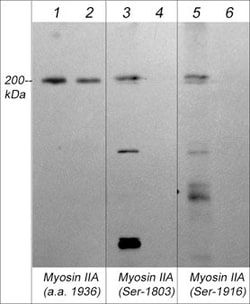
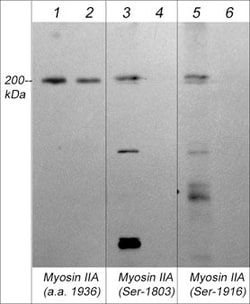
- The antibody detects a 200 kDa* protein corresponding to NMHC-IIA on SDS-PAGE immunoblots of human A431, Jurkat, mouse C2C12, and rat PC12 cells
- This reactivity is removed after treatment with lambda phosphatase
- The antibody also detects NMHC-IIA (Ser-1943) phosphorylation in chick Fibroblasts
- TMP21 is a ubiquitously expressed protein that is involved in vesicular targeting and protein transport
- More recent experiments have shown that it is also a component in the presenilin complex and modulates the -gamma-secretase but not the epsilon-secretase cleavage activity of the amyloid precursor protein
- The presenilin complex is composed of the proteins APH1, nicastrin, and PEN2 in addition to presenilin-1
- Together, these proteins cleave the amyloid precursor protein at what is known as the -gamma- and epsilon-sites and can lead to the accumulation of the Abeta cleavage product that is associated with Alzheimer's disease
- Co-immunoprecipitation experiments using antibodies against these proteins also yielded TMP21 indicating that TMP21 may play a role in the regulation of this complex
- Suppression of TMP21 expression by siRNA in transfected cells caused increased -gamma-secretase activity but not epsilon-secretase activity, and increased Abeta production, demonstrating that TMP21 can modulate -gamma-secretase activity.