PSME1 Polyclonal Antibody, Invitrogen™
Manufacturer: Thermo Scientific
Select a Size
| Pack Size | SKU | Availability | Price |
|---|---|---|---|
| Each of 1 | PIPA518707-Each-of-1 | In Stock | ₹ 46,502.50 |
PIPA518707 - Each of 1
In Stock
Quantity
1
Base Price: ₹ 46,502.50
GST (18%): ₹ 8,370.45
Total Price: ₹ 54,872.95
Antigen
PSME1
Classification
Polyclonal
Conjugate
Unconjugated
Gene
PSME1
Gene Alias
11S regulator complex subunit alpha; 29-kD MCP activator subunit; activator of multicatalytic protease subunit 1; AW413925; epididymis secretory sperm binding protein Li 129m; HEL-S-129m; I79_008549; IFI5111; IGUP I-5111; interferon gamma up-regulated I-5111 protein; interferon-gamma IEF SSP 5111; interferon-gamma-inducible protein 5111; MGC8628; OTTHUMP00000164702; PA28 alpha subunit; PA28a; PA28alpha; protease (prosome, macropain) 28 subunit, alpha; proteasome (prosome, macropain) 28 subunit, alpha; proteasome (prosome, macropain) activator subunit 1; proteasome (prosome, macropain) activator subunit 1 (PA28 alpha); proteasome activator 28 subunit alpha; Proteasome activator complex subunit 1; proteasome activator subunit 1; Psme1; REGalpha; REG-alpha
Host Species
Goat
Purification Method
Ammonium sulfate precipitation
Regulatory Status
RUO
Gene ID (Entrez)
5720
Content And Storage
-20° C, Avoid Freeze/Thaw Cycles
Form
Liquid
Applications
Western Blot
Concentration
0.5 mg/mL
Formulation
TBS with 0.5% BSA and 0.02% sodium azide; pH 7.3
Gene Accession No.
Q06323
Gene Symbols
PSME1
Immunogen
Synthetic peptide sequence (KNFEKLKKPRGETK) corresponding to the C-terminus amino acids of PSME1
Quantity
100 μg
Primary or Secondary
Primary
Target Species
Human
Product Type
Antibody
Isotype
IgG
Related Products


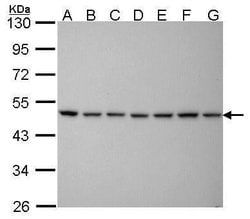


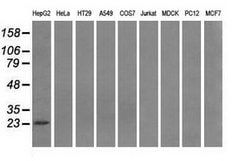
Description
- This antibody is predicted to react with canine, mouse and rat based on sequence homology
- This antibody is tested in Peptide ELISA: antibody detection limit dilution 64,000
- Proteolytic degradation is critical to the maintenance of appropriate levels of short-lived and regulatory proteins as important and diverse as those involved in cellular metabolism, heat shock and stress response, antigen presentation, modulation of cell surface receptors and ion channels, cell cycle regulation, transcription, and signalling factors
- The ubiquitin-proteasome pathway deconstructs most proteins in the eukaryotic cell cytosol and nucleus
- Others are degraded via the vacuolar pathway which includes endosomes, lysosomes, and the endoplasmic reticulum
- The 26S proteasome is an ATP-dependent, multisubunit (approximately 31), barrel-shaped molecular machine with an apparent molecular weight of approximately 2.5 MDa
- It consists of a 20S proteolytic core complex which is crowned at one or both ends by 19S regulatory subunit complexes
- The 19S regulatory subunits recognize ubiquitinated proteins and play an essential role in unfolding and translocating targets into the lumen of the 20S subunit
- An enzymatic cascade is responsible for the attachment of multiple ubiquitin molecules to lysine residues of proteins targeted for degradation
- Several genetic diseases are associated with defects in the ubiquitin-proteasome pathway
- Some examples of affected proteins include those linked to cystic fibrosis, Angelman's syndrome, and Liddle syndrome.