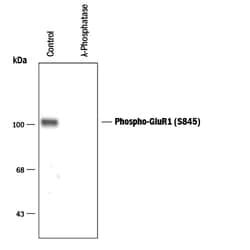
Phospho-GluR1 (Thr840) Polyclonal Antibody, Invitrogen™
Manufacturer: Thermo Scientific
Select a Size
| Pack Size | SKU | Availability | Price |
|---|---|---|---|
| Each of 1 | PIPA519451-Each-of-1 | In Stock | ₹ 42,898.00 |
PIPA519451 - Each of 1
In Stock
Quantity
1
Base Price: ₹ 42,898.00
GST (18%): ₹ 7,721.64
Total Price: ₹ 50,619.64
Antigen
Phospho-GluR1 (Thr840)
Classification
Polyclonal
Conjugate
Unconjugated
Gene Accession No.
P23818, P19490
Gene Symbols
GRIA1
Immunogen
Synthetic peptide conjugated to KLH derived from within residues 850 to the C-terminus of Mouse Glutamate Receptor 1 (AMPA subtype), phosphorylated at pThr840
Quantity
100 μg
Primary or Secondary
Primary
Target Species
Mouse, Rat
Product Type
Antibody
Isotype
IgG
Applications
Immunofluorescence, Immunohistochemistry (Frozen), Immunoprecipitation, Western Blot
Concentration
0.4 mg/mL
Gene
Gria1
Gene Alias
GLUH1, GLUR1, GLURA, GluA1, HBGR1, MGC133252, AMPA 1; AMPA-selective glutamate receptor 1; gluR-1; gluR-A; gluR-K1; glutamate receptor 1
Host Species
Rabbit
Purification Method
Antigen affinity chromatography
Regulatory Status
RUO
Gene ID (Entrez)
14799, 50592
Content And Storage
-20°C or -80°C if preferred
Form
Liquid
Related Products
Description
- This antibody is predicted to react with human based on sequence homology
- GluR1 (glutamate receptor 1) is an ionotropic glutamate receptor
- L-glutamate acts as an excitatory neurotransmitter at many synapses in the central nervous system
- Binding of the excitatory neurotransmitter, L-glutamate, induces a conformation change that leads to the opening of the cation channel and converts the chemical signal to an electrical impulse
- Then, the receptor desensitizes rapidly and enters a transiet inactive state characterized by the presence of a bound agonist
- In the presence of CACNG4, CACNG7, or CACNG8 GluR1 shows resensitization which is characterized by a delayed accumulation of current flux upon continued application of glutamate.