ATG12 Polyclonal Antibody, Invitrogen™
Manufacturer: Thermo Scientific
Select a Size
| Pack Size | SKU | Availability | Price |
|---|---|---|---|
| Each of 1 | PIPA520464-Each-of-1 | In Stock | ₹ 46,502.50 |
PIPA520464 - Each of 1
In Stock
Quantity
1
Base Price: ₹ 46,502.50
GST (18%): ₹ 8,370.45
Total Price: ₹ 54,872.95
Antigen
ATG12
Classification
Polyclonal
Conjugate
Unconjugated
Gene
ATG12
Gene Alias
4931423H11Rik; A330058M13Rik; APG 12; APG12; Apg12 (autophagy, yeast) homolog; APG12L; APG12-like; ATG12; ATG12 autophagy related 12 homolog; Atg12l; Atg12p; Atg12-PB; Autophagy protein 12-like; autophagy related 12; autophagy related protein 12; autophagy-related 12; autophagy-related protein 12; Autophagy-specific gene 12; CG10861; CG10861-PB; Dmel\CG10861; Dmel_CG10861; FBR93; HAPG12; IP05205p; IP05405p; OTTHUMP00000159129; ubiquitin-like protein ATG12; YBR1506; YBR217W
Host Species
Rabbit
Purification Method
Antigen affinity chromatography
Regulatory Status
RUO
Gene ID (Entrez)
361321, 67526, 9140
Content And Storage
Maintain refrigerated at 2-8°C for up to 3 months. For long term storage store at -20°C
Form
Liquid
Applications
Immunohistochemistry, Western Blot
Concentration
1 mg/mL
Formulation
PBS with 0.02% sodium azide
Gene Accession No.
O94817, Q2TBJ5, Q9CQY1
Gene Symbols
ATG12
Immunogen
A 15 amino acid peptide from near the center of human ATG12.
Quantity
100 μg
Primary or Secondary
Primary
Target Species
Human, Mouse, Rat
Product Type
Antibody
Isotype
IgG
Related Products
Description
- A suggested positive control is mouse heart tissue lysate
- PA5-20464 can be used with blocking peptide PEP-0581
- ATG12, a member of the autophagy protein family, forms a conjugate with ATG5; this conjugate has a ubiquitin-protein ligase (E3)-like activity for protein lipidation in autophagy
- This conjugate also associates with innate immune response proteins such as RIG-I and VISA (also known as IPS-1), inhibiting type I interferon production and permitting viral replication in host cells
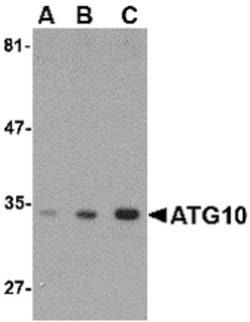
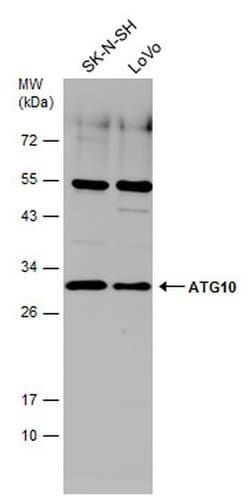
- ATG12 has also been shown to interact with ATG10 in human embryonic kidney cells in the presence of ATG7
- At least two isoforms of ATG12 are known to exist
- Autophagy, the process of bulk degradation of cellular proteins through an autophagosomic-lysosomal pathway is important for normal growth control and may be defective in tumor cells
- It is involved in the preservation of cellular nutrients under starvation conditions as well as the normal turnover of cytosolic components
- This process is negatively regulated by TOR (Target of rapamycin) through phosphorylation of autophagy protein APG1.