PYCARD Polyclonal Antibody, Invitrogen™
Manufacturer: Thermo Scientific
Select a Size
| Pack Size | SKU | Availability | Price |
|---|---|---|---|
| Each of 1 | PIPA527715-Each-of-1 | In Stock | ₹ 46,591.50 |
PIPA527715 - Each of 1
In Stock
Quantity
1
Base Price: ₹ 46,591.50
GST (18%): ₹ 8,386.47
Total Price: ₹ 54,977.97
Antigen
PYCARD
Classification
Polyclonal
Conjugate
Unconjugated
Gene
PYCARD
Gene Alias
9130417A21Rik; Apoptosis-associated speck-like protein containing a CARD; Asc; CARD5; caspase recruitment domain-containing protein 5; hASC; mASC; MGC10332; Pycard; PYD and CARD domain containing; PYD and CARD domain-containing protein; Target of methylation-induced silencing 1; TMS; TMS1; TMS-1; TNS1
Host Species
Rabbit
Purification Method
Antigen affinity chromatography
Regulatory Status
RUO
Gene ID (Entrez)
29108
Content And Storage
Store at 4°C short term. For long term storage, store at -20°C, avoiding freeze/thaw cycles.
Form
Liquid
Applications
Immunocytochemistry, Immunohistochemistry (Frozen), Western Blot
Concentration
1 mg/mL
Formulation
PBS with 1% BSA, 20% glycerol and 0.01% thimerosal; pH 7
Gene Accession No.
Q9ULZ3
Gene Symbols
PYCARD
Immunogen
Recombinant fragment corresponding to a region within amino acids 1 and 195 of Human TMS1
Quantity
100 μL
Primary or Secondary
Primary
Target Species
Human
Product Type
Antibody
Isotype
IgG
Related Products



Description
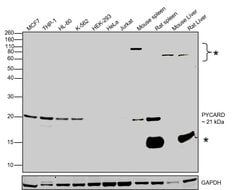
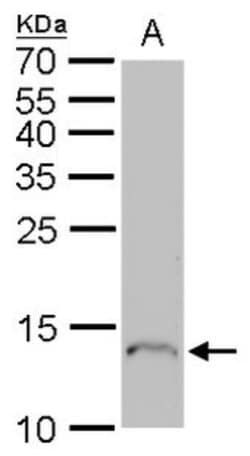
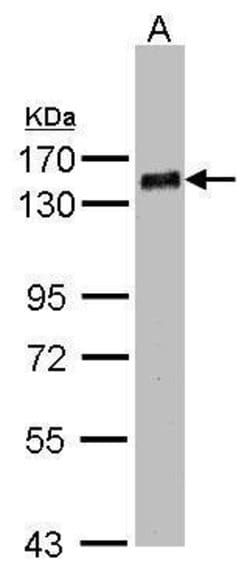
- Recommended positive controls: THP-1, 3xFlag-human TMS1-transfected 293T
- Predicted reactivity: Rhesus Monkey (91%)
- Store product as a concentrated solution
- Centrifuge briefly prior to opening the vial
- Functions as key mediator in apoptosis and inflammation
- Promotes caspase-mediated apoptosis involving predominantly caspase-8 and also caspase-9 in a probable cell type-specific manner
- Involved in activation of the mitochondrial apoptotic pathway, promotes caspase-8-dependent proteolytic maturation of BID independently of FADD in certain cell types and also mediates mitochondrial translocation of BAX and activates BAX-dependent apoptosis coupled to activation of caspase-9, -2 and -3
- Involved in macrophage pyroptosis, a caspase-1-dependent inflammatory form of cell death and is the major constituent of the ASC pyroptosome which forms upon potassium depletion and rapidly recruits and activates caspase-1
- In innate immune response believed to act as an integral adapter in the assembly of the inflammasome which activates caspase-1 leading to processing and secretion of proinflammatory cytokines
- The function as activating adapter in different types of inflammasomes is mediated by the pyrin and CARD domains and their homotypic interactions
- Required for recruitment of caspase-1 to inflammasomes containing certain pattern recognition receptors, such as NLRP2, NLRP3, AIM2 and probably IFI16
- In the NLRP1 and NLRC4 inflammasomes seems not be required but facilitates the processing of procaspase-1
- In cooperation with NOD2 involved in an inflammasome activated by bacterial muramyl dipeptide leading to caspase-1 activation
- May be involved in DDX58-triggered proinflammatory responses and inflammasome activation
- Isoform 2 may have a regulating effect on the function as inflammasome adapter
- Isoform 3 seems to inhibit inflammasome-mediated maturation of interleukin-1 beta
- In collaboration with AIM2 which detects cytosolic double-stranded DNA may also be involved in a caspase-1-independent cell death that involves caspase-8
- In adaptive immunity may be involved in maturation of dendritic cells to stimulate T-cell immunity and in cytoskeletal rearrangements coupled to chemotaxis and antigen uptake may be involved in post-transcriptional regulation of the guanine nucleotide exchange factor DOCK2; the latter function is proposed to involve the nuclear form
- Also involved in transcriptional activation of cytokines and chemokines independent of the inflammasome; this function may involve AP-1, NF-kappa-B, MAPK and caspase-8 signaling pathways
- For regulation of NF-kappa-B activating and inhibiting functions have been reported
- Modulates NF-kappa-B induction at the level of the IKK complex by inhibiting kinase activity of CHUK and IKBK
- Proposed to compete with RIPK2 for association with CASP1 thereby down-regulating CASP1-mediated RIPK2-dependent NF-kappa-B activation and activating interleukin-1 beta processing.