GSTM5 Polyclonal Antibody, Invitrogen™
Manufacturer: Thermo Scientific
Select a Size
| Pack Size | SKU | Availability | Price |
|---|---|---|---|
| Each of 1 | PIPA527981-Each-of-1 | In Stock | ₹ 47,392.50 |
PIPA527981 - Each of 1
In Stock
Quantity
1
Base Price: ₹ 47,392.50
GST (18%): ₹ 8,530.65
Total Price: ₹ 55,923.15
Antigen
GSTM5
Classification
Polyclonal
Conjugate
Unconjugated
Gene
GSTM5
Gene Alias
fibrous sheath component 2; Fsc2; glutathione S-alkyltransferase M5; glutathione S-aralkyltransferase M5; glutathione S-aryltransferase M5; glutathione S-transferase M5; glutathione S-transferase Mu 5; glutathione S-transferase, mu 5; glutathione-S-transferase, mu 5; GST class-mu 5; Gstm3; GSTM5; GSTM5-5; GTM5; S-(hydroxyalkyl)glutathione lyase M5
Host Species
Rabbit
Purification Method
Antigen affinity chromatography
Regulatory Status
RUO
Gene ID (Entrez)
14866, 2949
Content And Storage
Store at 4°C short term. For long term storage, store at -20°C, avoiding freeze/thaw cycles.
Form
Liquid
Applications
Western Blot
Concentration
1 mg/mL
Formulation
PBS with 20% glycerol and 0.01% thimerosal; pH 7
Gene Accession No.
P46439, P48774
Gene Symbols
GSTM5
Immunogen
Recombinant fragment corresponding to a region within amino acids 1 and 218 of Human GSTM5
Quantity
100 μL
Primary or Secondary
Primary
Target Species
Human, Mouse
Product Type
Antibody
Isotype
IgG
Related Products


Description
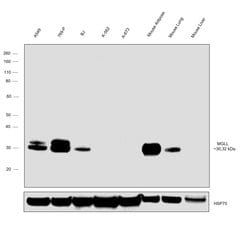
- Recommended positive controls: mouse brain
- Store product as a concentrated solution
- Centrifuge briefly prior to opening the vial
- Cytosolic and membrane-bound forms of glutathione S-transferase are encoded by two distinct supergene families
- At present, eight distinct classes of the soluble cytoplasmic mammalian glutathione S-transferases have been identified: alpha, kappa, mu, omega, pi, sigma, theta and zeta
- This gene encodes a glutathione S-transferase that belongs to the mu class
- The mu class of enzymes functions in the detoxification of electrophilic compounds, including carcinogens, therapeutic drugs, environmental toxins and products of oxidative stress, by conjugation with glutathione
- The genes encoding the mu class of enzymes are organized in a gene cluster on chromosome 1p13.3 and are known to be highly polymorphic
- These genetic variations can change an individual's susceptibility to carcinogens and toxins as well as affect the toxicity and efficacy of certain drugs
- Diversification of these genes has occurred in regions encoding substrate-binding domains, as well as in tissue expression patterns, to accommodate an increasing number of foreign compounds.