Ephrin B3 Polyclonal Antibody, Invitrogen™
Manufacturer: Thermo Scientific
Select a Size
| Pack Size | SKU | Availability | Price |
|---|---|---|---|
| Each of 1 | PIPA528831-Each-of-1 | In Stock | ₹ 47,392.50 |
PIPA528831 - Each of 1
In Stock
Quantity
1
Base Price: ₹ 47,392.50
GST (18%): ₹ 8,530.65
Total Price: ₹ 55,923.15
Antigen
Ephrin B3
Classification
Polyclonal
Conjugate
Unconjugated
Gene
EFNB3
Gene Alias
EFL6; EFL-6; Efnb3; ELF-3; Elk-L3; EPH-related receptor transmembrane ligand ELK-L3; eph-related receptor tyrosine kinase ligand 8; ephrin B3; ephrin ligand B3; ephrin-B3; Epl8; EPLG8; LERK8; LERK-8; NLERK-2
Host Species
Rabbit
Purification Method
Antigen affinity chromatography
Regulatory Status
RUO
Gene ID (Entrez)
13643, 1949, 360546
Content And Storage
Store at 4°C short term. For long term storage, store at -20°C, avoiding freeze/thaw cycles.
Form
Liquid
Applications
Western Blot
Concentration
1 mg/mL
Formulation
0.1M tris glycine with 10% glycerol and 0.01% thimerosal; pH 7
Gene Accession No.
O35393, Q15768
Gene Symbols
EFNB3
Immunogen
Synthetic peptide corresponding to a region within amino acids 276 and 340 of Human ephrin-B3
Quantity
100 μL
Primary or Secondary
Primary
Target Species
Human, Mouse, Rat
Product Type
Antibody
Isotype
IgG
Related Products

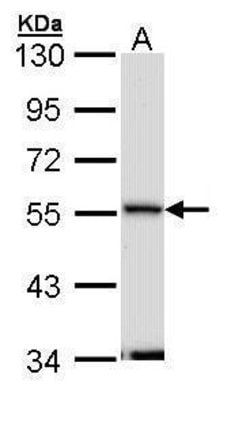

Description
- Recommended positive controls: 293T, A431, mouse hippocampus, rat hippocampus
- Predicted reactivity: Mouse (100%), Rat (100%), Dog (100%), Cat (100%), Pig (100%), Bovine (100%)
- Store product as a concentrated solution
- Centrifuge briefly prior to opening the vial
- EFNB3, a member of the ephrin gene family, is important in brain development as well as in its maintenance
- Moreover, since levels of EFNB3 expression were particularly high in several forebrain subregions compared to other brain subregions, it may play a pivotal role in forebrain function
- The EPH and EPH-related receptors comprise the largest subfamily of receptor protein-tyrosine kinases and have been implicated in mediating developmental events, particularly in the nervous system
- EPH Receptors typically have a single kinase domain and an extracellular region containing a Cys-rich domain and 2 fibronectin type III repeats
- The ephrin ligands and receptors have been named by the Eph Nomenclature Committee (1997)
- Based on their structures and sequence relationships, ephrins are divided into the ephrin-A (EFNA) class, which are anchored to the membrane by a glycosylphosphatidylinositol linkage, and the ephrin-B (EFNB) class, which are transmembrane proteins
- The Eph family of receptors are similarly divided into 2 groups based on the similarity of their extracellular domain sequences and their affinities for binding ephrin-A and ephrin-B ligands.