PIPA530056
HAS3 Polyclonal Antibody, Invitrogen™
Manufacturer: Thermo Scientific
Select a Size
| Pack Size | SKU | Availability | Price |
|---|---|---|---|
| Each of 1 | PIPA530056-Each-of-1 | In Stock | ₹ 47,392.50 |
PIPA530056 - Each of 1
In Stock
Quantity
1
Base Price: ₹ 47,392.50
GST (18%): ₹ 8,530.65
Total Price: ₹ 55,923.15
Antigen
HAS3
Classification
Polyclonal
Conjugate
Unconjugated
Gene
HAS3
Gene Alias
HA synthase 3; Has3; Hyaluronan synthase 3; hyaluronate synthase 3; Hyaluronic acid synthase 3
Host Species
Rabbit
Purification Method
Antigen affinity chromatography
Regulatory Status
RUO
Gene ID (Entrez)
3038
Content And Storage
Store at 4°C short term. For long term storage, store at -20°C, avoiding freeze/thaw cycles.
Form
Liquid
Applications
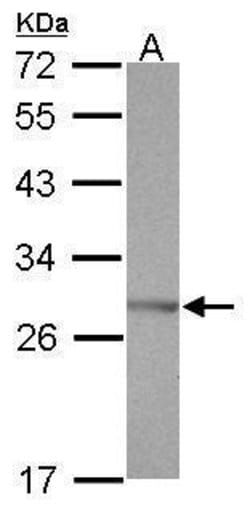
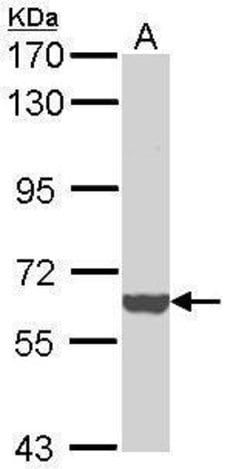
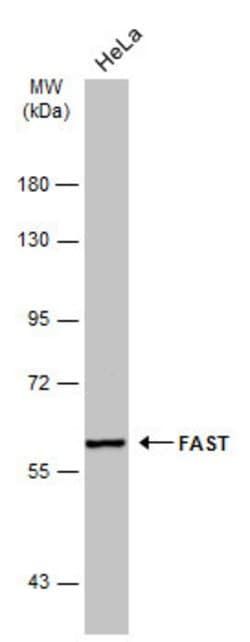
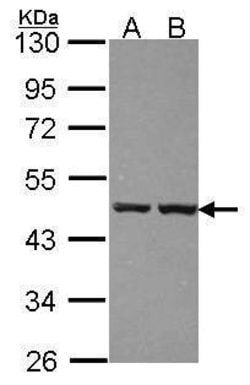
Western Blot
Concentration
0.89 mg/mL
Formulation
0.1M tris glycine with 20% glycerol and 0.01% thimerosal; pH 7
Gene Accession No.
O00219
Gene Symbols
HAS3
Immunogen
Recombinant protein fragment corresponding to a region within amino acids 44 and 250 of Human HAS3
Quantity
100 μL
Primary or Secondary
Primary
Target Species
Human
Product Type
Antibody
Isotype
IgG
Related Products


Description
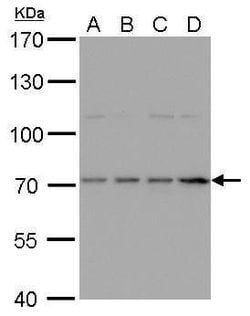
- Recommended positive controls: NT2D1, PC-3, SK-N-SH
- Predicted reactivity: Mouse (94%), Rat (95%), Pig (97%), Rabbit (97%), Rhesus Monkey (96%), Bovine (98%)
- Store product as a concentrated solution
- Centrifuge briefly prior to opening the vial
- HAS1, HAS2 and HAS3 are HA (hyaluronan or hyaluronic acid) synthase proteins
- The extracellular matrix in most vertebrates express HA, which is a high molecular weight linear polysaccharide composed of alternating glucuronic acid and N-acetylglucosamine residues linked by b-1,3 and b-1,4 glycosidic bonds
- The three HAS genes show distinct patterns of expression during development and their protein products play significantly different roles in the formation of the HA matrix
- Both HAS1 and HAS2 synthesize high molecular-weight HA, whereas HAS3 produces lower molecular weight HA
- The expression of the three HAS isoforms is more prominent in growing cells than in resting cells and is differentially regulated by various stimuli, suggesting distinct functional roles of the three proteins
- HAS3 produces both secreted and cell-associated forms of hyaluronan and is the most active of the three isoforms of this enzyme in adults
- HAS3 gene expression plays a crucial role in the regulation of hyaluronan synthesis in the epidermis
- Specifically, IFN-g markedly upregulates HAS3 mRNA, whereas TGFbeta downregulates HAS3 transcript levels
- The human HAS3 gene maps to chromosome 16q22
- 1.