RHAMM Polyclonal Antibody, Invitrogen™
Manufacturer: Thermo Scientific
Select a Size
| Pack Size | SKU | Availability | Price |
|---|---|---|---|
| Each of 1 | PIPA531870-Each-of-1 | In Stock | ₹ 48,905.50 |
PIPA531870 - Each of 1
In Stock
Quantity
1
Base Price: ₹ 48,905.50
GST (18%): ₹ 8,802.99
Total Price: ₹ 57,708.49
Antigen
RHAMM
Classification
Polyclonal
Conjugate
Unconjugated
Gene
HMMR
Gene Alias
AA386826; CD168; Hmmr; Hyaluronan mediated motility receptor; hyaluronan mediated motility receptor (RHAMM); hyaluronan-mediated motility receptor; hyaluronan-mediated motility receptor (RHAMM); IHABP; Intracellular hyaluronic acid-binding protein; receptor for hyaluronan-mediated motility; RHAMM
Host Species
Rabbit
Purification Method
Antigen affinity chromatography
Regulatory Status
RUO
Gene ID (Entrez)
25460, 3161
Content And Storage
Store at 4°C short term. For long term storage, store at -20°C, avoiding freeze/thaw cycles.
Form
Liquid
Applications
Immunohistochemistry (Paraffin), Immunoprecipitation, Western Blot
Concentration
1 mg/mL
Formulation
PBS with 1% BSA, 20% glycerol and 0.01% thimerosal; pH 7
Gene Accession No.
O75330, P97779
Gene Symbols
HMMR
Immunogen
Recombinant protein fragment corresponding to a region within amino acids 1 and 198 of Human RHAMM
Quantity
100 μL
Primary or Secondary
Primary
Target Species
Human, Rat
Product Type
Antibody
Isotype
IgG
Related Products
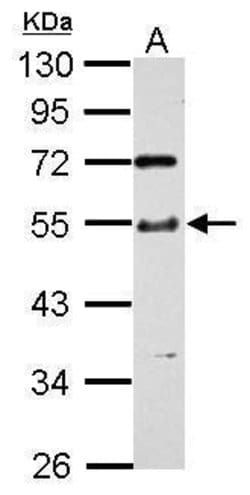
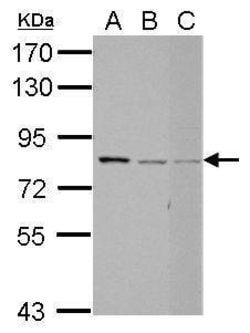
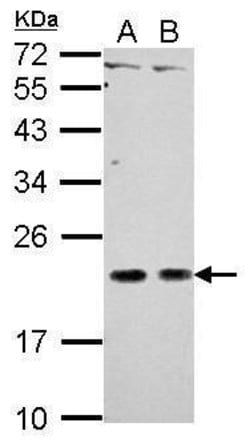
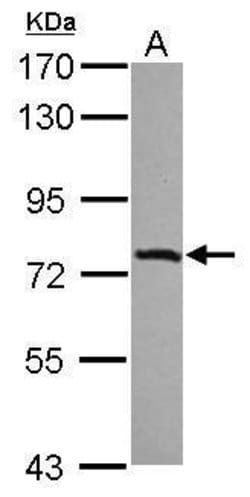
Description
- Recommended positive controls: human ESC
- Predicted reactivity: Human (99%), Bovine (85%)
- Store product as a concentrated solution
- Centrifuge briefly prior to opening the vial
- The protein encoded by this gene is involved in cell motility
- It is expressed in breast tissue and together with other proteins, it forms a complex with BRCA1 and BRCA2, thus is potentially associated with higher risk of breast cancer
- Alternatively spliced transcript variants encoding different isoforms have been noted for this gene.