PIPA532186
THAP11 Polyclonal Antibody, Invitrogen™
Manufacturer: Thermo Scientific
Select a Size
| Pack Size | SKU | Availability | Price |
|---|---|---|---|
| Each of 1 | PIPA532186-Each-of-1 | In Stock | ₹ 46,502.50 |
PIPA532186 - Each of 1
In Stock
Quantity
1
Base Price: ₹ 46,502.50
GST (18%): ₹ 8,370.45
Total Price: ₹ 54,872.95
Antigen
THAP11
Classification
Polyclonal
Conjugate
Unconjugated
Gene
THAP11
Gene Alias
2810036E22Rik; AB041579; CTG-B43a; CTG-B45d; HRIHFB2206; MNCb-2032; Ronin; THAP domain containing 11; THAP domain-containing protein 11; Thap11
Host Species
Rabbit
Purification Method
Antigen affinity chromatography
Regulatory Status
RUO
Gene ID (Entrez)
57215, 59016
Content And Storage
Store at 4°C short term. For long term storage, store at -20°C, avoiding freeze/thaw cycles.
Form
Liquid
Applications
Western Blot
Concentration
1 mg/mL
Formulation
PBS with 1% BSA, 20% glycerol and 0.01% thimerosal; pH 7
Gene Accession No.
Q96EK4, Q9JJD0
Gene Symbols
THAP11
Immunogen
Recombinant protein fragment corresponding to a region within amino acids 1 and 128 of Human THAP11
Quantity
100 μL
Primary or Secondary
Primary
Target Species
Human, Mouse
Product Type
Antibody
Isotype
IgG
Related Products
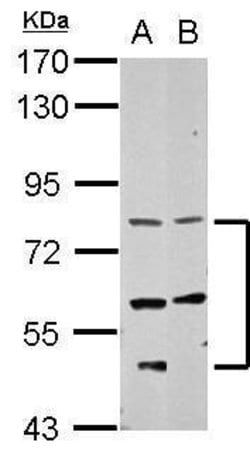
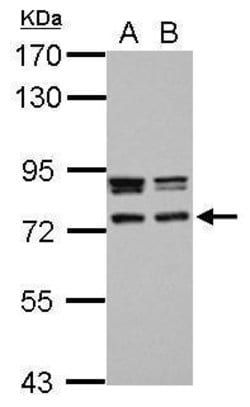
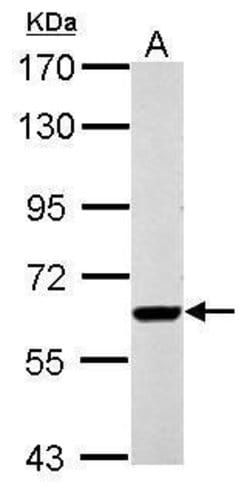
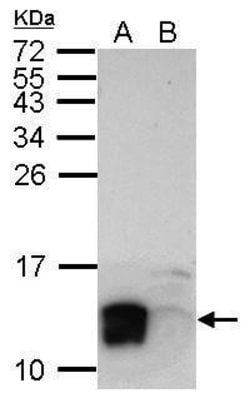
Description
- Recommended positive controls: mouse ESC
- Predicted reactivity: Human (99%), Mouse (90%), Rat (94%), Bovine (90%)
- Store product as a concentrated solution
- Centrifuge briefly prior to opening the vial
- This gene encodes two proteins, the SART1protein expressed in the nucleus of the majority of proliferating cells, and the SART1protein expressed in the cytosol of epithelial cancers
- The SART1protein is translated by the mechanism of -1 frameshifting during posttranscriptional regulation; its full-length sequence is not published yet
- The two encoded proteins are thought to be involved in the regulation of proliferation
- Both proteins have tumor-rejection antigens
- The SART1protein possesses tumor epitopes capable of inducing HLA-A2402-restricted cytotoxic T lymphocytes in cancer patients
- This SART1antigen may be useful in specific immunotherapy for cancer patients and may serve as a paradigmatic tool for the diagnosis and treatment of patients with atopy
- The SART1protein is found to be essential for the recruitment of the tri-snRNP to the pre-spliceosome in the spliceosome assembly pathway.