HTR1E Polyclonal Antibody, Invitrogen™
Manufacturer: Thermo Scientific
Select a Size
| Pack Size | SKU | Availability | Price |
|---|---|---|---|
| Each of 1 | PIPA533297-Each-of-1 | In Stock | ₹ 46,502.50 |
PIPA533297 - Each of 1
In Stock
Quantity
1
Base Price: ₹ 46,502.50
GST (18%): ₹ 8,370.45
Total Price: ₹ 54,872.95
Antigen
HTR1E
Classification
Polyclonal
Formulation
PBS with 0.1% sodium azide
Gene Accession No.
P28566, Q6VB83
Gene Symbols
HTR1E
Immunogen
Synthetic 16 amino acid peptide from 3rd cytoplasmic domain of human 5HT1E Receptor.
Quantity
50 μg
Primary or Secondary
Primary
Target Species
Bovine, Guinea Pig, Human, Non-human Primate
Product Type
Antibody
Isotype
IgG
Applications
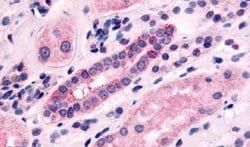
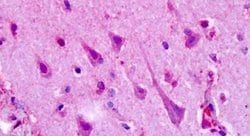
Immunohistochemistry (Paraffin)
Conjugate
Unconjugated
Gene
HTR1E
Gene Alias
5-HT1E; 5-HT-1E; 5HT1E Receptor; 5-HT1e receptor; 5-hydroxytryptamine (serotonin) receptor 1E, G protein-coupled; 5-hydroxytryptamine receptor 1E; HT1e receptor; HTR1E; S31; serotonin receptor 1E
Host Species
Rabbit
Purification Method
Antigen affinity chromatography
Regulatory Status
RUO
Gene ID (Entrez)
100379275, 3354, 616356
Content And Storage
Store at 4°C short term. For long term storage, store at -20°C, avoiding freeze/thaw cycles.
Form
Liquid
Related Products


Description
- Percent identity with other species by BLAST analysis: Human, Chimpanzee, Gorilla, Orangutan, Gibbon, Monkey, Elephant, Bovine, Bat, Horse, Guinea pig (100%)
- G-protein coupled receptor for 5-hydroxytryptamine (serotonin)
- Also functions as a receptor for various alkaloids and psychoactive substances
- Ligand binding causes a conformation change that triggers signaling via guanine nucleotide-binding proteins (G proteins) and modulates the activity of down-stream effectors, such as adenylate cyclase
- Signaling inhibits adenylate cyclase activity.