PIPA534107
PRKD2 Polyclonal Antibody, Invitrogen™
Manufacturer: Thermo Scientific
Select a Size
| Pack Size | SKU | Availability | Price |
|---|---|---|---|
| Each of 1 | PIPA534107-Each-of-1 | In Stock | ₹ 46,502.50 |
PIPA534107 - Each of 1
In Stock
Quantity
1
Base Price: ₹ 46,502.50
GST (18%): ₹ 8,370.45
Total Price: ₹ 54,872.95
Antigen
PRKD2
Classification
Polyclonal
Conjugate
Unconjugated
Gene
PRKD2
Gene Alias
AI325941; HSPC187; nPKC-D2; PKD2; Prkd2; protein kinase D2; RGD1308054; serine/threonine-protein kinase D2
Host Species
Rabbit
Purification Method
Antigen affinity chromatography
Regulatory Status
RUO
Gene ID (Entrez)
25865
Content And Storage
Store at 4°C short term. For long term storage, store at -20°C, avoiding freeze/thaw cycles.
Form
Liquid
Applications
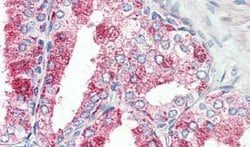
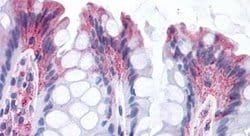
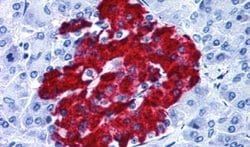
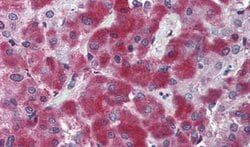
Immunohistochemistry (Paraffin)
Concentration
1 mg/mL
Formulation
PBS with 0.1% sodium azide
Gene Accession No.
Q9BZL6
Gene Symbols
PRKD2
Immunogen
Synthetic 18 amino acid peptide from internal region of human PRKD2.
Quantity
50 μg
Primary or Secondary
Primary
Target Species
Human, Non-human Primate
Product Type
Antibody
Isotype
IgG
Related Products

Description
- Percent identity with other species by BLAST analysis: Human, Gorilla, Gibbon, Monkey (100%) Marmoset, Dog (89%) Elephant, Panda (83%)
- PRKD2 (PKD2) is a member of the protein kinase D serine/threonine protein kinase family
- PRKD2 is a component in the signal transduction pathway induced by phorbol esters and the CCK b gastrin receptor
- It exhibits the strongest homology to the serine threonine protein kinases PKD/PKC and PKCnu, particularly in the duplex zinc finger-like cysteine-rich motif, in the pleckstrin homology domain and in the protein kinase domain
- In contrast, it shows only a low degree of sequence similarity to other members of the PKC family.