PIPA558111
WDR36 Polyclonal Antibody, Invitrogen™
Manufacturer: Thermo Scientific
Select a Size
| Pack Size | SKU | Availability | Price |
|---|---|---|---|
| Each of 1 | PIPA558111-Each-of-1 | In Stock | ₹ 48,905.50 |
PIPA558111 - Each of 1
In Stock
Quantity
1
Base Price: ₹ 48,905.50
GST (18%): ₹ 8,802.99
Total Price: ₹ 57,708.49
Antigen
WDR36
Classification
Polyclonal
Conjugate
Unconjugated
Gene
WDR36
Gene Alias
GLC1G; TAWDRP; TA-WDRP; T-cell activation WD repeat protein; T-cell activation WD repeat-containing protein; UTP21; WD repeat domain 36; WD repeat-containing protein 36; WDR36
Host Species
Rabbit
Purification Method
Antigen affinity chromatography
Regulatory Status
RUO
Gene ID (Entrez)
134430
Content And Storage
Store at 4°C short term. For long term storage, store at -20°C, avoiding freeze/thaw cycles.
Form
Liquid
Applications
Immunohistochemistry
Concentration
0.2 mg/mL
Formulation
PBS with 40% glycerol and 0.02% sodium azide; pH 7.2
Gene Accession No.
Q8NI36
Gene Symbols
WDR36
Immunogen
Recombinant protein corresponding to Human WDR36
Quantity
100 μL
Primary or Secondary
Primary
Target Species
Human
Product Type
Antibody
Isotype
IgG
Related Products

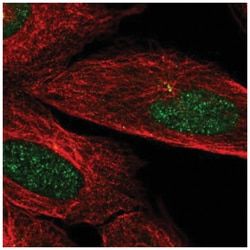
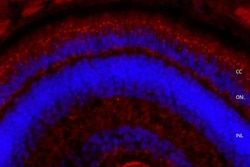
Description
- Immunogen sequence: NKSLGHGLIN KKRVKRKGLQ NTMSVRLPPI TKFAAEEARE SDWDGIIACH QGKLSCSTWN YQKSTIGAYF LKPKELKKDD ITATAVDITS CGNF Highest antigen sequence identity to the following orthologs: Mouse - 85%, Rat - 85%
- This gene encodes a member of the WD repeat protein family
- WD repeats are minimally conserved regions of approximately 40 amino acids typically bracketed by gly-his and trp-asp (GH-WD), which may facilitate formation of heterotrimeric or multiprotein complexes
- Members of this family are involved in a variety of cellular processes, including cell cycle progression, signal transduction, apoptosis, and gene regulation
- Mutations in this gene have been associated with adult-onset primary open-angle glaucoma (POAG).