ANGPTL3 Polyclonal Antibody, Invitrogen™
Manufacturer: Thermo Scientific
Select a Size
| Pack Size | SKU | Availability | Price |
|---|---|---|---|
| Each of 1 | PIPA558245-Each-of-1 | In Stock | ₹ 48,905.50 |
PIPA558245 - Each of 1
In Stock
Quantity
1
Base Price: ₹ 48,905.50
GST (18%): ₹ 8,802.99
Total Price: ₹ 57,708.49
Antigen
ANGPTL3
Classification
Polyclonal
Conjugate
Unconjugated
Gene
ANGPTL3
Gene Alias
ANG-5; angiopoietin 5; angiopoietin like 3; Angiopoietin-5; angiopoietin-like 3; angiopoietin-like protein 3; Angiopoietin-related protein 3; ANGPT5; ANGPTL3; ANGPTL3(17-221); ANGPTL3(17-224); ANL3; FHBL2; hypl; hypolipidemia; UNQ153/PRO179
Host Species
Rabbit
Purification Method
Antigen affinity chromatography
Regulatory Status
RUO
Gene ID (Entrez)
27329
Content And Storage
Store at 4°C short term. For long term storage, store at -20°C, avoiding freeze/thaw cycles.
Form
Liquid
Applications
Immunohistochemistry, Western Blot
Concentration
0.1 mg/mL
Formulation
PBS with 40% glycerol and 0.02% sodium azide; pH 7.2
Gene Accession No.
Q9Y5C1
Gene Symbols
ANGPTL3
Immunogen
Recombinant protein corresponding to Human ANGPTL3
Quantity
100 μL
Primary or Secondary
Primary
Target Species
Human
Product Type
Antibody
Isotype
IgG
Related Products
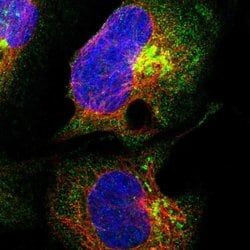


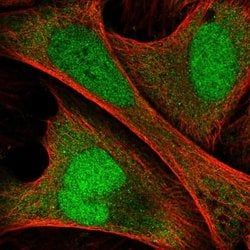
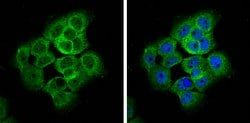
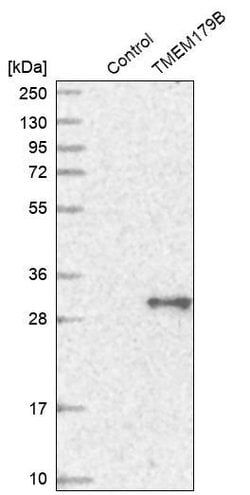
Description
- Immunogen sequence: QDNSSFDSLS PEPKSRFAML DDVKILANGL LQLGHGLKDF VHKTKGQIND IFQKLNIFDQ SFYDLSLQTS EIKEEEKELR RT Highest antigen sequence identity to the following orthologs: Mouse - 91%, Rat - 90%
- This gene encodes a member of a family of secreted proteins that function in angiogenesis
- The encoded protein, which is expressed predominantly in the liver, is further processed into an N-terminal coiled-coil domain-containing chain and a C-terminal fibrinogen chain
- The N-terminal chain is important for lipid metabolism, while the C-terminal chain may be involved in angiogenesis
- Mutations in this gene cause familial hypobetalipoproteinemia type 2.