PIPA558434
HAL Polyclonal Antibody, Invitrogen™
Manufacturer: Thermo Scientific
Select a Size
| Pack Size | SKU | Availability | Price |
|---|---|---|---|
| Each of 1 | PIPA558434-Each-of-1 | In Stock | ₹ 48,905.50 |
PIPA558434 - Each of 1
In Stock
Quantity
1
Base Price: ₹ 48,905.50
GST (18%): ₹ 8,802.99
Total Price: ₹ 57,708.49
Antigen
HAL
Classification
Polyclonal
Conjugate
Unconjugated
Gene
HAL
Gene Alias
hal; HIS; histidase; histidine ammonia lyase; histidine ammonia-lyase; histidinemia; Hsd; HSTD; Huth; zgc:136980
Host Species
Rabbit
Purification Method
Antigen affinity chromatography
Regulatory Status
RUO
Gene ID (Entrez)
3034
Content And Storage
Store at 4°C short term. For long term storage, store at -20°C, avoiding freeze/thaw cycles.
Form
Liquid
Applications
Immunohistochemistry
Concentration
0.3 mg/mL
Formulation
PBS with 40% glycerol and 0.02% sodium azide; pH 7.2
Gene Accession No.
P42357
Gene Symbols
HAL
Immunogen
Recombinant protein corresponding to Human HAL
Quantity
100 μL
Primary or Secondary
Primary
Target Species
Human
Product Type
Antibody
Isotype
IgG
Related Products


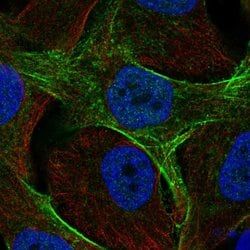
Description
- Immunogen sequence: FVEVVIEGDA MSPDFIPSQP EGVYLYSKYR EPEKYIELDG DRLTTEDLVN LGKGRYKIKL TPTAEKRVQK SREVIDSIIK EKTVVYGITT GFGKFARTV Highest antigen sequence identity to the following orthologs: Mouse - 90%, Rat - 89%
- HAL is a cytosolic enzyme catalyzing the first reaction in histidine catabolism, the nonoxidative deamination of L-histidine to trans-urocanic acid
- HAL defects cause histidinemia which is characterized by increased histidine and histamine and decreased urocanic acid in body fluids Histidine ammonia-lyase is a cytosolic enzyme catalyzing the first reaction in histidine catabolism, the nonoxidative deamination of L-histidine to trans-urocanic acid
- Histidine ammonia-lyase defects cause histidinemia which is characterized by increased histidine and histamine and decreased urocanic acid in body fluids.