EID2 Polyclonal Antibody, Invitrogen™
Manufacturer: Thermo Scientific
Select a Size
| Pack Size | SKU | Availability | Price |
|---|---|---|---|
| Each of 1 | PIPA561012-Each-of-1 | In Stock | ₹ 48,905.50 |
PIPA561012 - Each of 1
In Stock
Quantity
1
Base Price: ₹ 48,905.50
GST (18%): ₹ 8,802.99
Total Price: ₹ 57,708.49
Antigen
EID2
Classification
Polyclonal
Conjugate
Unconjugated
Gene
EID2
Gene Alias
CREBBP/EP300 inhibitor 2; CREBBP/EP300 inhibitory protein 2; Cri2; E1A like inhibitor of differentiation 2; EID-1-like inhibitor of differentiation 2; Eid2; EID-2; EP300 interacting inhibitor of differentiation 2; EP300-interacting inhibitor of differentiation 2
Host Species
Rabbit
Purification Method
Antigen affinity chromatography
Regulatory Status
RUO
Gene ID (Entrez)
163126
Content And Storage
Store at 4°C short term. For long term storage, store at -20°C, avoiding freeze/thaw cycles.
Form
Liquid
Applications
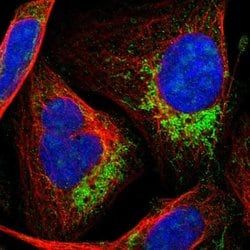
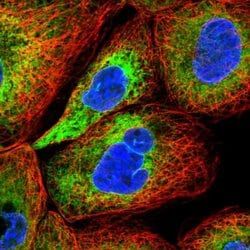
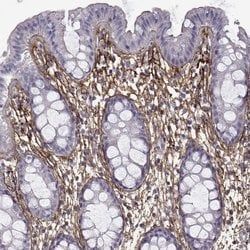
Immunocytochemistry, Immunohistochemistry
Concentration
0.1 mg/mL
Formulation
PBS with 40% glycerol and 0.02% sodium azide; pH 7.2
Gene Accession No.
Q8N6I1
Gene Symbols
EID2
Immunogen
Recombinant protein corresponding to Human EID2
Quantity
100 μL
Primary or Secondary
Primary
Target Species
Human
Product Type
Antibody
Isotype
IgG
Related Products



Description
- Immunogen sequence: AREAAFDAEY QRNPHRVDLD ILTFTIALTA SEVINPLIEE LGCDKFINRE Highest antigen sequence identity to the following orthologs: Mouse - 90%, Rat - 90%
- EID2 interacts with EP300 and acts as a repressor of MYOD-dependent transcription and muscle differentiation
- Inhibits EP300 histone acetyltransferase activity
- Acts as a repressor of TGFB/SMAD transcriptional responses
- It may act as a repressor of the TGFB/SMAD3-dependent signaling by selectively blocking formation of TGFB-induced SMAD3-SMAD4 complex.