ACBD4 Polyclonal Antibody, Invitrogen™
Manufacturer: Thermo Scientific
Select a Size
| Pack Size | SKU | Availability | Price |
|---|---|---|---|
| Each of 1 | PIPA562477-Each-of-1 | In Stock | ₹ 48,905.50 |
PIPA562477 - Each of 1
In Stock
Quantity
1
Base Price: ₹ 48,905.50
GST (18%): ₹ 8,802.99
Total Price: ₹ 57,708.49
Antigen
ACBD4
Classification
Polyclonal
Conjugate
Unconjugated
Gene
ACBD4
Gene Alias
2010009P05Rik; 2010015A21Rik; Acbd4; acyl-CoA binding domain containing 4; acyl-CoA-binding domain-containing protein 4; acyl-Coenzyme A binding domain containing 4; AI849317; FLJ13322; FLJ90623; HMFT0700; similar to acyl-Coenzyme A binding domain containing 4; zgc:85611
Host Species
Rabbit
Purification Method
Antigen affinity chromatography
Regulatory Status
RUO
Gene ID (Entrez)
79777
Content And Storage
Store at 4°C short term. For long term storage, store at -20°C, avoiding freeze/thaw cycles.
Form
Liquid
Applications
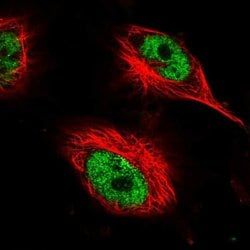
Immunocytochemistry, Immunohistochemistry
Concentration
0.1 mg/mL
Formulation
PBS with 40% glycerol and 0.02% sodium azide; pH 7.2
Gene Accession No.
Q8NC06
Gene Symbols
ACBD4
Immunogen
Recombinant protein corresponding to Human ACBD4
Quantity
100 μL
Primary or Secondary
Primary
Target Species
Human
Product Type
Antibody
Isotype
IgG
Related Products



Description
- Immunogen sequence: SAYITEMKLV AQKVIDTVPL GEVAEDMFGY FEPLYQVIPD MPRPPETFLR RVTGWKEQVV NGDVGAVSEP PCLPKEPA Highest antigen sequence identity to the following orthologs: Mouse - 82%, Rat - 87%
- ACBD4 is a member of the acyl-coenzyme A binding domain containing protein family
- All family members contain the conserved acyl-Coenzyme A binding domain, which binds acyl-CoA thiol esters
- They are thought to play roles in acyl-CoA dependent lipid metabolism.