PIPA563213
TMEM100 Polyclonal Antibody, Invitrogen™
Manufacturer: Thermo Scientific
Select a Size
| Pack Size | SKU | Availability | Price |
|---|---|---|---|
| Each of 1 | PIPA563213-Each-of-1 | In Stock | ₹ 48,905.50 |
PIPA563213 - Each of 1
In Stock
Quantity
1
Base Price: ₹ 48,905.50
GST (18%): ₹ 8,802.99
Total Price: ₹ 57,708.49
Antigen
TMEM100
Classification
Polyclonal
Conjugate
Unconjugated
Gene
TMEM100
Gene Alias
EGK_08550; TMEM100; Transmembrane protein 100
Host Species
Rabbit
Purification Method
Antigen affinity chromatography
Regulatory Status
RUO
Gene ID (Entrez)
55273
Content And Storage
Store at 4°C short term. For long term storage, store at -20°C, avoiding freeze/thaw cycles.
Form
Liquid
Applications
Immunohistochemistry
Concentration
0.05 mg/mL
Formulation
PBS with 40% glycerol and 0.02% sodium azide; pH 7.2
Gene Accession No.
Q9NV29
Gene Symbols
TMEM100
Immunogen
Recombinant protein corresponding to Human TMEM100
Quantity
100 μL
Primary or Secondary
Primary
Target Species
Human
Product Type
Antibody
Isotype
IgG
Related Products



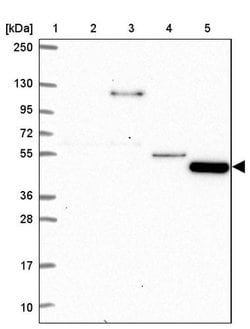

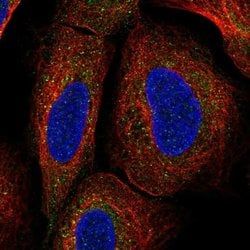
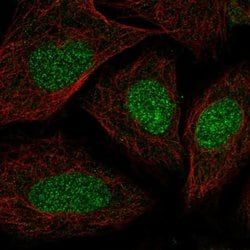
Description
- Immunogen sequence: MTEEPIKEIL GAPKAHMAAT MEKSPKSEVV ITTVPLVSEI QLMAATG Highest antigen sequence identity to the following orthologs: Mouse - 72%, Rat - 77%
- Plays a role during embryonic arterial endothelium differentiation and vascular morphogenesis through the ACVRL1 receptor-dependent signaling pathway upon stimulation by bone morphogenetic proteins, such as GDF2/BMP9 and BMP10
- Involved in the regulation of nociception, acting as a modulator of the interaction between TRPA1 and TRPV1, two molecular sensors and mediators of pain signals in dorsal root ganglia (DRG) neurons
- Mechanistically, it weakens their interaction, thereby releasing the inhibition of TRPA1 by TRPV1 and increasing the single-channel open probability of the TRPA1-TRPV1 complex
- [UniProt]