Septin-9 Polyclonal Antibody, Invitrogen™
Manufacturer: Thermo Scientific
Select a Size
| Pack Size | SKU | Availability | Price |
|---|---|---|---|
| Each of 1 | PIPA565629-Each-of-1 | In Stock | ₹ 48,905.50 |
PIPA565629 - Each of 1
In Stock
Quantity
1
Base Price: ₹ 48,905.50
GST (18%): ₹ 8,802.99
Total Price: ₹ 57,708.49
Antigen
Septin-9
Classification
Polyclonal
Conjugate
Unconjugated
Gene
SEPTIN9
Gene Alias
AF17q25; eighth septin; Eseptin; E-septin; KIAA0991; MLL septin-like fusion; MLL septin-like fusion protein; MLL septin-like fusion protein MSF-A; MSF; MSF1; NAPB; Ov/Br septin; ovarian/breast septin; PNUTL4; SEPT9; SeptD1; septin 9; septin D1; SEPTIN9; Septin-9; septin-like protein; Sint1; SL3-3 integration site 1 protein; SLP; Slpa
Host Species
Rabbit
Purification Method
Antigen affinity chromatography
Regulatory Status
RUO
Gene ID (Entrez)
10801
Content And Storage
Store at 4°C short term. For long term storage, store at -20°C, avoiding freeze/thaw cycles.
Form
Liquid
Applications
Immunocytochemistry
Concentration
0.4 mg/mL
Formulation
PBS with 40% glycerol and 0.02% sodium azide; pH 7.2
Gene Accession No.
Q9UHD8
Gene Symbols
SEPTIN9
Immunogen
Recombinant Human Septin-9
Quantity
100 μL
Primary or Secondary
Primary
Target Species
Human
Product Type
Antibody
Isotype
IgG
Related Products

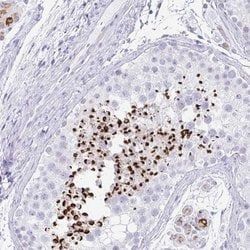
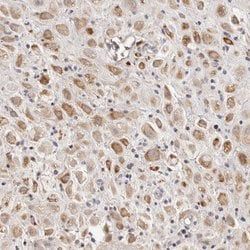
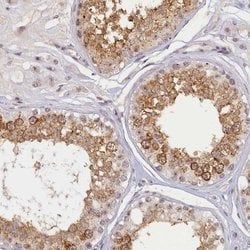
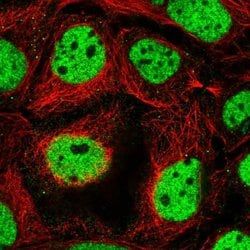
Description
- Immunogen sequence: PAPVSQLQSRL EPKPQPPVAE ATPRSQEATE AAPSCVGDMA DTPRDAGLKQ APASRNEKAP VDFGYVGIDS Highest antigen sequence identity to the following orthologs - mouse 75%, rat 77%
- The maf oncogene was identified by structural analysis of the AS42 avian transforming retrovirus genome
- The Maf family is divided into two subclasses, large Mafs (vMaf, cMaf, MafB and Nrl) and small Mafs (MafF, MafK, and MafG)
- Both subclasses contain leucinezipper motifs, which allow homodimerization as well as heterodimerization with a variety of other bZip transcription factors
- Large Mafs also contain an acidic transactivation domain absent in the small Maf proteins
- Although they do not possess inherent transactivation activity, small Maf proteins can act as positive regulators of transcription by targeting transcriptionally active dimerization partners to specific DNA regulatory elements
- Conversely, small Mafs can act also as negative regulators of transcription by recruiting transcriptional repressors or by forming homodimers that can replace active dimers
- Human MafF was isolated in a yeast one-hybrid system from a human myometrium cDNA library
- Human MAFF encodes a 164 amino acids proten
- Like other small MAFF proteins, it contains an extended leucine zipper structure and lacks an N-terminal transactivating domain
- The three small Maf proteins have been implicated in a number of physiological processes, including development, differentiation, haematopoiesis and stress response
- Interestingly, these three proteins regulate the stress response via different mechanisms.