WNT2 Polyclonal Antibody, Invitrogen™
Manufacturer: Thermo Scientific
Select a Size
| Pack Size | SKU | Availability | Price |
|---|---|---|---|
| Each of 1 | PIPA568544-Each-of-1 | In Stock | ₹ 46,502.50 |
PIPA568544 - Each of 1
In Stock
Quantity
1
Base Price: ₹ 46,502.50
GST (18%): ₹ 8,370.45
Total Price: ₹ 54,872.95
Antigen
WNT2
Classification
Polyclonal
Conjugate
Unconjugated
Gene
Wnt2
Gene Alias
2610510E18Rik; etID309852.18; INT1L 1; Int1l1; int-1-like protein 1; INT-1-related protein; IRP; IRP protein; Mirp; protein Wnt-2; secreted growth factor; wingless-related MMTV integration site 2; wingless-type MMTV integration site 2; wingless-type MMTV integration site family member 2; wingless-type MMTV integration site family, member 2; Wnt; WNT 2; Wnt family member 2; Wnt2; Wnt-2; Wnt2a; ZfWnt2
Host Species
Rabbit
Purification Method
Affinity chromatography
Regulatory Status
RUO
Gene ID (Entrez)
22413
Content And Storage
-20° C, Avoid Freeze/Thaw Cycles
Form
Liquid
Applications
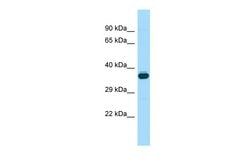
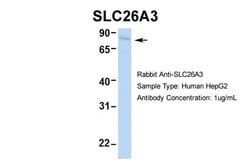
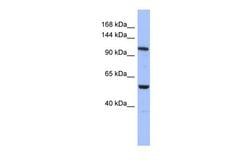
Western Blot
Concentration
0.5 mg/mL
Formulation
PBS with 2% sucrose and 0.09% sodium azide
Gene Accession No.
P21552
Gene Symbols
Wnt2
Immunogen
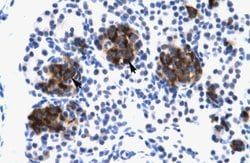
synthetic peptide directed towards the middle region of human WNT2
Quantity
100 μL
Primary or Secondary
Primary
Target Species
Mouse
Product Type
Antibody
Isotype
IgG
Related Products




Description
- This target displays homology in the following species: Cow: 100%; Dog: 100%; Guinea Pig: 100%; Horse: 100%; Human: 100%; Mouse: 100%; Rabbit: 100%; Rat: 100%; Sheep: 100%; Zebrafish: 92% WNT2 is a ligand for members of the frizzled family of seven transmembrane receptors
- Probable developmental protein
- May be a signaling molecule which affects the development of discrete regions of tissues
- Is likely to signal over only few cell diameters.