PIPA568616
TBX4 Polyclonal Antibody, Invitrogen™
Manufacturer: Thermo Scientific
Select a Size
| Pack Size | SKU | Availability | Price |
|---|---|---|---|
| Each of 1 | PIPA568616-Each-of-1 | In Stock | ₹ 46,502.50 |
PIPA568616 - Each of 1
In Stock
Quantity
1
Base Price: ₹ 46,502.50
GST (18%): ₹ 8,370.45
Total Price: ₹ 54,872.95
Antigen
TBX4
Classification
Polyclonal
Conjugate
Unconjugated
Gene
TBX4
Gene Alias
3930401C23; ICPPS; SPS; T-box 4; T-box 4 protein; T-box protein 4; T-box transcription factor 4; T-box transcription factor TBX4; Tbx4; transcription factor Tbx4
Host Species
Rabbit
Purification Method
Affinity chromatography
Regulatory Status
RUO
Gene ID (Entrez)
303399
Content And Storage
-20° C, Avoid Freeze/Thaw Cycles
Form
Liquid
Applications
Western Blot
Concentration
0.5 mg/mL
Formulation
PBS with 2% sucrose and 0.09% sodium azide
Gene Accession No.
0
Gene Symbols
TBX4
Immunogen
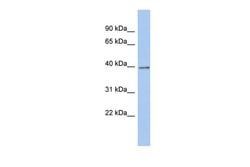
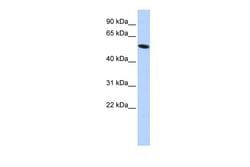
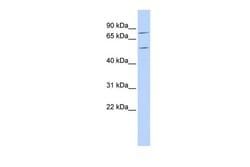
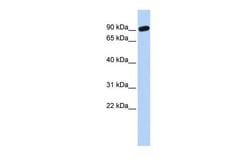
synthetic peptide directed towards the N-terminal region of rat TBX4
Quantity
100 μL
Primary or Secondary
Primary
Target Species
Rat
Product Type
Antibody
Isotype
IgG
Related Products


Description
- This target displays homology in the following species: Cow: 93%; Dog: 93%; Human: 100%; Mouse: 100%; Pig: 86%; Rabbit: 93%; Rat: 100% This gene is a member of a phylogenetically conserved family of genes that share a common DNA-binding domain, the T-box
- T-box genes encode transcription factors involved in the regulation of developmental processes
- This gene is the human homolog of mouse Tbx4, which is closely linked to Tbx2 on mouse chromosome 11
- Similarly this gene, like TBX2, maps to human chromosome 17
- Expression studies in mouse and chicken show that Tbx4 is expressed in developing hindlimb, but not in forelimb buds, suggesting a role for this gene in regulating limb development and specification of limb identity.