PIPA568716
ELOA2 Polyclonal Antibody, Invitrogen™
Manufacturer: Thermo Scientific
Select a Size
| Pack Size | SKU | Availability | Price |
|---|---|---|---|
| Each of 1 | PIPA568716-Each-of-1 | In Stock | ₹ 46,502.50 |
PIPA568716 - Each of 1
In Stock
Quantity
1
Base Price: ₹ 46,502.50
GST (18%): ₹ 8,370.45
Total Price: ₹ 54,872.95
Antigen
ELOA2
Classification
Polyclonal
Conjugate
Unconjugated
Gene
ELOA2
Gene Alias
EloA2; Elongin-A2; HsT832; RNA polymerase II transcription factor SIII subunit A2; TCEB3B; TCEB3L; transcription elongation factor (SIII) elongin A2 elongin A2; transcription elongation factor B polypeptide 3B; transcription elongation factor B subunit 3B
Host Species
Rabbit
Purification Method
Affinity chromatography
Regulatory Status
RUO
Gene ID (Entrez)
51224
Content And Storage
-20° C, Avoid Freeze/Thaw Cycles
Form
Liquid
Applications
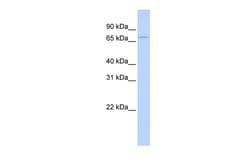
Western Blot
Concentration
0.5 mg/mL
Formulation
PBS with 2% sucrose and 0.09% sodium azide
Gene Accession No.
Q8IYF1
Gene Symbols
ELOA2
Immunogen
synthetic peptide directed towards the middle region of human ELOA2
Quantity
100 μL
Primary or Secondary
Primary
Target Species
Human
Product Type
Antibody
Isotype
IgG
Related Products

Description
- This target displays homology in the following species: Human: 100% This gene encodes the transcriptionally active subunit of the SIII (or elongin) transcription elongation factor complex, which also includes two regulatory subunits, elongins B and C
- This complex acts to increase the rate of RNA chain elongation by RNA polymerase II by suppressing transient pausing of the polymerase at many sites along the DNA template
- Whereas a related protein with similar function, elongin A, is ubiquitously expressed, the encoded protein is specifically expressed in the testis, suggesting it may have a role in spermatogenesis.