SAP102 Polyclonal Antibody, Invitrogen™
Manufacturer: Thermo Scientific
Select a Size
| Pack Size | SKU | Availability | Price |
|---|---|---|---|
| Each of 1 | PIPA578501-Each-of-1 | In Stock | ₹ 49,261.50 |
PIPA578501 - Each of 1
In Stock
Quantity
1
Base Price: ₹ 49,261.50
GST (18%): ₹ 8,867.07
Total Price: ₹ 58,128.57
Antigen
SAP102
Classification
Polyclonal
Conjugate
Unconjugated
Gene
DLG3
Gene Alias
discs large homolog 3; discs large MAGUK scaffold protein 3; discs, large homolog 3; discs, large homolog 3 (Drosophila); disks large homolog 3; DLG3; Dlgh3; KIAA1232; mKIAA1232; MRX; MRX90; NEDLG; Neuroendocrine-DLG; PPP1R82; protein phosphatase 1, regulatory subunit 82; PSD-95/SAP90-related protein 1; SAP102; SAP-102; synapse-associated protein 102; XLMR
Host Species
Rabbit
Purification Method
Antigen affinity chromatography
Regulatory Status
RUO
Gene ID (Entrez)
53310, 58948
Content And Storage
Store at 4°C short term. For long term storage, store at -20°C, avoiding freeze/thaw cycles.
Form
Liquid
Applications
Immunocytochemistry, Immunohistochemistry (Paraffin), Western Blot
Concentration
0.42 mg/mL
Formulation
PBS with 1% BSA, 20% glycerol and 0.025% ProClin 300; pH 7
Gene Accession No.
P70175, Q62936
Gene Symbols
DLG3
Immunogen
Recombinant protein encompassing a sequence within the N-terminus region of mouse SAP102. The exact sequence is proprietary.
Quantity
100 μL
Primary or Secondary
Primary
Target Species
Mouse, Rat
Product Type
Antibody
Isotype
IgG
Related Products




Description
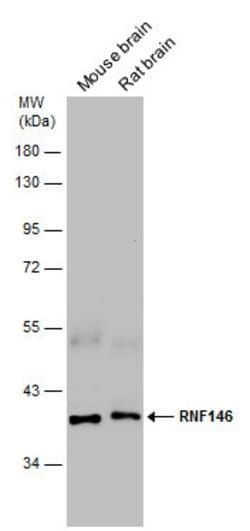
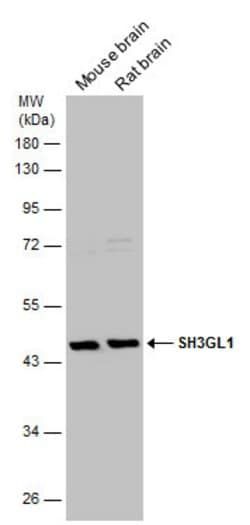
- Positive Control: mouse brain, rat brain Predicted Reactivity: Human (96%), Rhesus Monkey (96%), Bovine (95%) Store product as a concentrated solution
- Centrifuge briefly prior to opening the vial
- Synapse-Associated Protein 102 (SAP102) is one of a family of plasma membrane-associated proteins found in synaptic junctions
- Like other members of the family, SAP102 has three approximately 90 amino acid repeats called PDZ domains followed by an SH3 domain and a yeast guanylate kinase homology (GuK) domain
- It is hypothesized that PDZ-domain interactions play a role in receptor and channel clustering which contributes to neuronal plasticity
- SAP102 is believed to participate in the clustering of certain proteins, including NMDA receptors, shaker-type potassium channels at the synaptic membrane in CNS neurons
- NMDA receptors and Shaker-type potassium channels both share C-terminal sequence homology consisting of a threonine/serine-X-valine-COOH (T/SXV) motif
- Other neuronal proteins that share this motif (beta 1 adrenergic receptor, some serotonin receptors, some sodium channel subunits, and additional potassium channel subunits) may interact with SAP102 by binding to its PDZ domains
- Neuronal nitric oxide synthase (nNOS), which lacks the T/SXV motif but which has its own PDZ domain, has been shown to associate with SAP102 in vitro through a pseudo-homotypic PDZ-PDZ interaction.