MAX Polyclonal Antibody, Invitrogen™
Manufacturer: Thermo Scientific
Select a Size
| Pack Size | SKU | Availability | Price |
|---|---|---|---|
| Each of 1 | PIPA580800-Each-of-1 | In Stock | ₹ 32,040.00 |
PIPA580800 - Each of 1
In Stock
Quantity
1
Base Price: ₹ 32,040.00
GST (18%): ₹ 5,767.20
Total Price: ₹ 37,807.20
Antigen
MAX
Classification
Polyclonal
Conjugate
Unconjugated
Gene
MAX
Gene Alias
AA960152; AI875693; bHLHd4; bHLHd5; bHLHd6; bHLHd7; bHLHd8; Class D basic helix-loop-helix protein 4; Delta-Max; Max; Max protein; MGC10775; MGC11225; MGC18164; MGC34679; MGC36767; MYC associated factor X; myc-associated factor X; Myc-binding novel HLH/LZ protein; Myn; orf1; Protein max; protein myn
Host Species
Rabbit
Purification Method
Antigen affinity chromatography, Protein A
Regulatory Status
RUO
Gene ID (Entrez)
4149
Content And Storage
Store at 4°C short term. For long term storage, store at -20°C, avoiding freeze/thaw cycles.
Form
Liquid
Applications
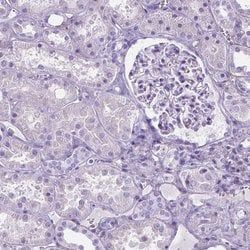
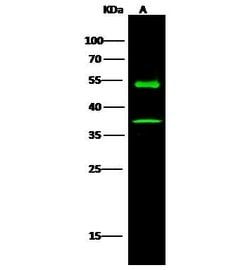
ELISA, Immunoprecipitation, Western Blot
Concentration
1 mg/mL
Formulation
PBS with no preservative
Gene Accession No.
P61244
Gene Symbols
MAX
Immunogen
Recombinant Human MYC associated factor X protein (Met1-Ser160)
Quantity
100 μL
Primary or Secondary
Primary
Target Species
Human
Product Type
Antibody
Isotype
IgG
Related Products

Description
- This product is preservative free
- It is recommended to add sodium azide to avoid contamination (final concentration 0.05%-0.1%)
- This antibody has specificity for Human MYC associated factor X
- The protein encoded by this gene is a member of the basic helix-loop-helix leucine zipper (bHLHZ) family of transcription factors
- It is able to form homodimers and heterodimers with other family members, which include Mad, Mxi1 and Myc
- Myc is an oncoprotein implicated in cell proliferation, differentiation and apoptosis
- The homodimers and heterodimers compete for a common DNA target site (the E box) and rearrangement among these dimer forms provides a complex system of transcriptional regulation
- Multiple alternatively spliced transcript variants have been described for this gene but the full-length nature for some of them is unknown.